
Retail Industry in Japan
The retail industry in Japan operates within one of the world’s largest and most sophisticated consumer markets, combining enormous metropolitan shopping districts, department stores, shopping centres, convenience-store networks, supermarkets, specialist retailers, luxury boutiques and increasingly integrated physical and digital commerce. Tokyo provides Japan with one of the most internationally visible retail environments in the world, but substantial commercial activity extends across Osaka, Yokohama, Nagoya, Fukuoka, Sapporo, Kyoto, Kobe, Sendai and numerous regional cities. Behind these consumer-facing environments sits an extensive B2B infrastructure involving retail installation companies, shopfitters, transport and logistics providers, manufacturers, suppliers, technology specialists, warehouse operators and businesses responsible for moving equipment from production through distribution to completed stores.

Japan remains a particularly important physical retail market because stores perform functions extending beyond straightforward product sales. Presentation, service, convenience and customer experience remain fundamental across many retail categories, while tourism adds another dimension to major shopping destinations. Department stores, luxury flagships, electronics stores, fashion retailers and compact convenience stores demonstrate very different approaches to physical retail, yet all depend on carefully planned environments and reliable supporting supply chains. Digital commerce continues to influence consumer behaviour, but rather than eliminating stores, it increasingly changes how physical locations interact with online ordering, collection, returns, inventory and customer services.
For companies operating across the wider retail supply chain, this creates opportunities throughout the lifecycle of Japanese stores. New locations require design, manufacturing, freight, warehousing, installation and technical support before opening, while established stores generate continuing requirements through refurbishment, display replacement, technology upgrades, maintenance, rebranding and changes to merchandising. Large retail estates can consequently create substantial ongoing commercial activity even when businesses are not opening significant numbers of completely new locations.
The wider retail industry in Japan therefore represents considerably more than retailers selling products to consumers. It connects brands, manufacturers, suppliers, logistics businesses, installation specialists and service providers across a complex domestic market while maintaining strong relationships with manufacturing and commercial networks throughout Asia and the wider world. For the Global Retail Directory, Japan represents an important international market where structured visibility between specialist companies can help businesses understand and connect with the wider commercial infrastructure supporting modern retail.
The Japanese Economy and Retail Market
Japan has one of the world’s largest developed economies, supported by advanced manufacturing, technology, automotive production, financial services, tourism, construction, transport and international trade. These industries interact with retail in numerous ways. Manufacturing produces consumer goods and commercial equipment, tourism supports shopping activity in major destinations, technology influences the operation of modern stores and Japan’s sophisticated transport infrastructure connects retail locations with domestic and international supply chains.
The structure of Japanese retail is exceptionally diverse. Large department stores remain prominent within metropolitan centres, while supermarkets and drugstores serve everyday consumer demand across urban and regional markets. Convenience stores are particularly significant, with dense networks providing food, beverages, household products and numerous additional services. Fashion, beauty, electronics, sporting goods, homeware and luxury retail create further specialist markets, while smaller independent retailers and traditional shopping streets continue to contribute to the commercial character of individual communities.
Japan’s demographic structure also influences the market. An ageing population and differences between rapidly growing metropolitan districts and smaller regional communities can affect store formats, product demand and investment decisions. Retailers need to consider convenience, accessibility and changing household structures while simultaneously responding to younger consumers who expect digital integration and rapid access to products and services.
For companies entering Japan from overseas, understanding these differences is important. A manufacturer supplying bespoke furniture to luxury stores in Tokyo faces completely different requirements from a business producing equipment for hundreds of convenience stores, while a logistics company supporting national rollouts needs coverage extending far beyond the major city centres. Successful participation in the Japanese retail market consequently depends on understanding not only consumers but also the operational relationships connecting different parts of the retail supply chain.
Tokyo and Japan’s Major Retail Cities
Tokyo occupies a unique position within the retail industry in Japan because it combines an enormous local population with international tourism, luxury retail, fashion, technology, entertainment and some of the most recognisable shopping districts in the world. Ginza is internationally associated with luxury boutiques, department stores and flagship locations, while Shibuya and Harajuku have considerable influence across fashion and youth culture. Shinjuku combines department stores, electronics, fashion, hospitality and entertainment within an exceptionally dense commercial environment, while Omotesando, Ikebukuro, Marunouchi and other districts provide further concentrations of specialist and premium retail.
For international brands, a Tokyo flagship can have strategic importance extending beyond the sales generated within that individual location. Stores can become showcases for architecture, design, technology and brand identity, attracting international visitors and media attention while demonstrating concepts that may subsequently influence stores elsewhere. This creates demanding requirements for businesses manufacturing and installing the physical environments because bespoke materials, furniture, displays and technology frequently need to meet extremely high standards.
Operating within Tokyo can nevertheless create substantial practical challenges for installation and logistics companies. Dense traffic, restricted loading areas, complex buildings, pedestrian environments and limited temporary storage can influence how equipment reaches a store. Large or fragile fixtures may require carefully coordinated delivery periods, while installation work may need to take place outside trading hours. A display manufactured perfectly can still create serious project problems if its dimensions, packaging or assembly sequence do not account for the actual route between the delivery vehicle and final installation position.
Japan’s retail economy extends far beyond Tokyo. Osaka provides another enormous metropolitan consumer market, with Umeda, Namba and Shinsaibashi among its major commercial districts. Yokohama forms part of the wider Greater Tokyo economy while supporting a substantial retail market of its own, Nagoya serves one of Japan’s most important industrial and commercial regions, and Fukuoka provides a major gateway to Kyushu and wider Asian markets. Sapporo, Kyoto, Kobe, Sendai and other regional cities create additional opportunities for national and international retailers. This geographic distribution means multi-site programmes can require carefully coordinated manufacturing, warehousing, logistics and installation coverage across considerable distances.
Shopping Districts, Shopping Centres and Retail Parks
Japanese retail operates through an unusually broad range of physical environments. Dense metropolitan shopping districts can combine department stores, shopping centres, specialist retailers and independent stores within relatively small areas, while major railway stations frequently incorporate substantial commercial environments of their own. Suburban shopping centres and larger destination developments provide different conditions, with greater floor areas and potentially easier vehicle access but often considerably larger quantities of equipment and merchandising infrastructure.
Department stores create particularly complex operational environments because numerous brands and concessions may operate within the same building. Deliveries, contractor access and installation programmes therefore need to be coordinated around trading activity, security requirements and other projects. Luxury boutiques create another set of requirements, particularly where expensive materials and bespoke furniture demand exceptional standards of handling and finishing.
Japan’s compact urban environments make accurate surveying particularly important. Standardised equipment can encounter different wall constructions, floor levels, access routes, ceiling conditions and store dimensions across different locations. These variations become particularly significant during national rollout programmes where one concept is being reproduced across many existing buildings.
For manufacturers and suppliers supporting the retail industry in Japan, designing equipment around realistic installation conditions can therefore provide a substantial operational advantage. Modular construction, clear identification, adjustable components, practical packaging and accurate installation documentation can help teams work more efficiently. Design, manufacturing, logistics and installation should consequently be considered connected stages of a retail programme rather than independent activities.
Retail Installation and Store Development
Retail installation in Japan includes a wide range of activities extending beyond complete shopfitting. Specialist businesses may install branded displays, furniture, shelving, counters, promotional equipment, digital screens, kiosks, signage, merchandising systems, technology equipment and other components forming part of modern retail environments. Projects can range from a single specialist installation to nationwide programmes covering hundreds of locations.
Large retailers continually modify their existing estates as products, technologies and store concepts develop. A substantial installation market can therefore exist without completely new stores being constructed. Existing environments require refurbishment, new promotional equipment, digital upgrades, fixture replacement and maintenance, while international brands need Japanese locations to remain consistent with changes being implemented elsewhere in their global estates.
Many installations must be completed while stores continue operating. Work can take place overnight, before opening or during restricted periods agreed with building or store management. Preparation becomes particularly important because teams may have only a limited working window. Equipment needs to arrive complete and undamaged, access arrangements must be confirmed, installers require appropriate tools and information, and unusual site conditions should ideally be identified before work begins.
Large rollout programmes multiply both efficiency and mistakes. A well-designed fixture with clear instructions can become faster to install as teams gain experience across successive locations. A manufacturing defect, incorrect component or inaccurate site survey can instead become a recurring problem affecting dozens of stores. Communication between project managers, manufacturers, warehouses, logistics providers and installation teams is therefore fundamental to maintaining programme quality and controlling costs.
Transport and Logistics Infrastructure
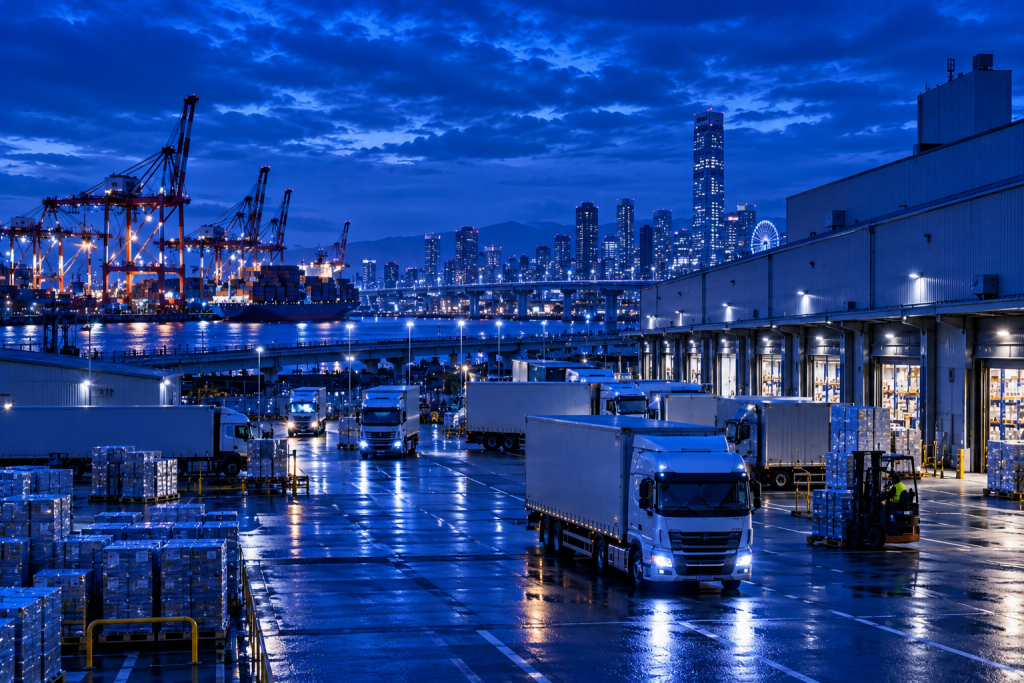
Japan’s extensive transport infrastructure is fundamental to the operation of its retail economy. Road networks connect metropolitan markets with warehouses, ports, airports and regional distribution centres, while rail, maritime and air transport provide additional connections across the country’s island geography and international supply chains.
Retail logistics includes everything from regular replenishment of consumer products to the movement of specialist store equipment. The requirements for these different types of freight can vary considerably. Standard merchandise can often move through established distribution systems, while bespoke displays, furniture, signage and technology may require specialist handling because individual components are fragile, oversized or allocated to specific stores.
The final stage of delivery can become particularly complicated in dense Japanese cities. Retail locations may have limited loading space, buildings can operate scheduled delivery systems and stores may have little capacity to hold equipment before installation. Delivering fixtures significantly ahead of programme can create storage and operational problems, while late delivery can leave installation teams unable to complete scheduled work.
Specialist retail transport therefore depends on coordination rather than simply moving equipment between two addresses. Warehouse teams, drivers, project managers, store personnel and installers may all need accurate information about delivery times, access requirements and the condition of equipment. For nationwide programmes, these relationships become increasingly important as equipment moves simultaneously toward numerous stores across different regions.
Ports, Airports and International Trade
Japan’s international trade infrastructure connects its retail economy with manufacturing and consumer markets around the world. Major maritime gateways around Tokyo Bay, Yokohama, Osaka, Kobe, Nagoya and other industrial regions handle enormous quantities of international freight, while airports including Narita, Haneda, Kansai and Chubu provide important connections for higher-value and time-sensitive cargo.
Retail equipment entering Japan may originate from manufacturing facilities elsewhere in Asia, Europe, North America or other regions. A fixture produced internationally can move through several stages before reaching the final store: factory production, international freight, customs processing, domestic warehousing, inspection, allocation and final-mile delivery. Each stage introduces potential handling risks and scheduling requirements.
Air freight can become relevant where urgent components, prototypes, electronics or replacement parts are required to protect a fixed store opening or rollout schedule. Transporting large quantities of conventional fixtures by air would generally be commercially inefficient, but the cost of moving a critical missing component rapidly can sometimes be significantly lower than delaying an opening or returning installation teams to multiple locations.
International manufacturers entering the retail industry in Japan therefore need to consider the entire support chain rather than focusing only on getting products into the country. Warehousing, inventory management, final-mile transport, installation and maintenance ultimately determine whether manufactured equipment performs successfully within the store.
Warehousing and Distribution Hubs
Warehousing plays a central role in Japanese retail supply chains because merchandise and equipment frequently require intermediate handling before reaching individual stores. Distribution facilities around major metropolitan and transport corridors allow goods to be received, inspected, stored and subsequently allocated according to regional or individual store requirements.
Retail installation programmes can require specialised warehouse operations. Equipment from several manufacturers may arrive separately but need to leave as complete packages for individual stores. Fixtures can be inspected for transit damage, components labelled by location and shipments released according to the installation programme rather than simply dispatching entire manufacturing batches at once.
Accurate inventory control becomes increasingly important as programme size increases. A rollout covering hundreds of locations can involve thousands of similar components configured for different store formats. An allocation error can affect more than one location because the store receiving the incorrect component and the store that should have received it can both experience disruption.
Connecting warehouse information with project management and field reporting therefore creates a stronger retail supply chain. Manufacturers can see what has arrived, project managers can understand which stores are ready, and installation teams can report missing or damaged equipment. The warehouse becomes an active operational connection between manufacturing, logistics and installation rather than simply a building where products wait.
Manufacturing and the Japanese Retail Supply Chain
Japan maintains internationally recognised manufacturing capabilities across automotive, electronics, machinery, materials, technology and consumer products, while its retailers and project organisations also source extensively from manufacturers elsewhere in Asia and internationally. Within physical retail, manufacturing can include furniture, metalwork, plastics, graphics, signage, lighting, shelving, counters, technology housings, packaging and bespoke branded displays.
The relationship between manufacturing and installation is particularly important because decisions taken during product development directly influence field efficiency. A fixture that appears straightforward within a manufacturing facility may be difficult to assemble within a compact urban store. Packaging may protect equipment exceptionally well during international freight but create unnecessary installation delays if components cannot be identified or unpacked efficiently during an overnight programme.
Clear labelling, practical assembly sequences, appropriate spare components and feedback from installation teams can consequently improve programme performance. Problems discovered before equipment leaves production can usually be resolved more efficiently than defects identified after international freight, warehousing and final-mile delivery.
The Global Retail Directory is designed to increase visibility between these different businesses. Manufacturers and suppliers can present their capabilities to companies looking for production partners, while installation and logistics specialists can become more discoverable to manufacturers requiring support within Japan or other international markets. The purpose is not to replace existing supply relationships but to make relevant specialist businesses easier to identify when new requirements arise.
Japanese Retailers and Iconic Brands
Japan has produced internationally recognised businesses across fashion, automotive, electronics, gaming, beauty, lifestyle and consumer goods. Japanese brands operate throughout the world, while Tokyo remains an important international showcase for both domestic and overseas retail concepts. This combination gives Japan substantial influence over store design, technology, merchandising and customer experience beyond its own borders.
For the Global Retail Directory, Iconic Brands form an important part of the wider industry landscape because major brands demonstrate the commercial ecosystems surrounding physical retail. Opening a flagship or implementing an international rollout does not involve only the retailer. Architects, designers, manufacturers, suppliers, technology companies, logistics businesses, installation contractors and maintenance specialists can all contribute to the finished environment.
Japanese brands expanding internationally can therefore generate commercial opportunities for specialist businesses in numerous countries. Equally, international retailers expanding their Japanese estates may require local partners capable of delivering the standards established elsewhere within their global operations.
Iconic Brands are consequently treated differently within GRD from the three commercial supplier categories. Their primary role is to strengthen the wider industry information network and demonstrate relationships between brands and the specialist companies supporting their physical retail environments. As the directory develops, this provides context around not only which organisations participate in retail but how the wider ecosystem connects.
Digital Retail and Omnichannel Development
Digital commerce continues to influence the retail industry in Japan, but physical and online retail increasingly operate as connected channels rather than completely separate markets. Consumers may research products digitally before visiting a store, order online for delivery, collect purchases through physical locations or use mobile services while shopping.
This changes what stores need to provide. Digital screens, interactive displays, self-service technology, collection facilities, electronic merchandising systems and connected inventory technology increasingly operate alongside conventional furniture and signage. Installation consequently becomes more technically complex because equipment may require physical mounting, electrical power, network connectivity, configuration and ongoing maintenance access.
Manufacturers also need to consider these requirements during product design. Cabling, ventilation, equipment replacement and connectivity are easier to manage when incorporated into fixtures from the beginning rather than added after manufacturing has been completed.
For installation companies, this creates an increasing overlap between conventional retail skills and technology deployment. A digital display may form part of a manufactured furniture system while still requiring mounting, connection, configuration and testing. Retailers increasingly expect completed environments to be operational immediately, meaning coordination between different technical contractors becomes particularly important.
Business Culture and Working Practices
Companies entering Japanese retail supply chains need to recognise that successful project delivery depends on communication, documentation, reliability and understanding local commercial expectations alongside technical capability. Requirements can vary according to the retailer, landlord, shopping centre, principal contractor and type of work being undertaken, making advance preparation important for overseas companies entering the market.
Communication becomes particularly significant during multinational programmes. Project management may operate from one country, manufacturing from another, warehousing within Japan and installation teams across several regions. Accurate schedules, installation documentation, completion photographs, site reports and rapid identification of defects allow these organisations to work together effectively.
Language should also be considered. International project documentation may be prepared in English, while site personnel and local operational information can require Japanese communication. Critical instructions, safety information and technical documentation need to be understood by the people actually completing the work rather than simply by management teams.
Commercial responsibilities should also be established clearly. Transport, warehousing, failed visits, damaged equipment, additional works and payment arrangements can become significant costs when misunderstandings are repeated across multiple locations. Strong retail partnerships are therefore built on reliability and communication as much as price.
Opportunities for International Retail Companies
Japan provides substantial opportunities for international businesses operating across retail installation, logistics, manufacturing and supply, but participating in the market does not necessarily require every overseas company to establish all operational capabilities internally. Partnerships can provide an effective route into the market.
An overseas manufacturer can retain control of design and production while working with Japanese warehousing, transport and installation partners to complete a rollout. An international project-management business may coordinate programmes centrally while local specialists provide physical coverage, and retailers entering Japan can work with established businesses rather than recreating complete supply networks from the beginning.
These relationships also operate in the opposite direction. Japanese manufacturers supplying international brands may require installation partners in Europe, North America, Australia, other Asian markets and elsewhere when equipment is exported. Logistics companies may require final-mile partners outside their established coverage, while specialist businesses that develop relationships with global brands can potentially follow those customers into additional countries.
The challenge is frequently discovery. A manufacturer may know that it needs installation coverage in Japan without knowing which businesses specialise in its equipment. A Japanese contractor may possess exactly the capabilities required by an international project organisation but remain largely invisible outside its existing network. A specialist logistics company may understand the handling requirements of high-value retail fixtures but be difficult to distinguish through a general internet search. Creating structured visibility between these businesses is one of the reasons the Global Retail Directory is being developed.
Connecting the Japanese Retail Industry Through Global Retail Directory
The Global Retail Directory is designed to connect companies operating across the wider international retail ecosystem. Businesses working within Japan can present their capabilities to potential partners domestically and internationally, while organisations outside Japan can discover retail installation companies, transport and logistics providers, manufacturers, suppliers and other specialist businesses capable of supporting projects within the Japanese market.