
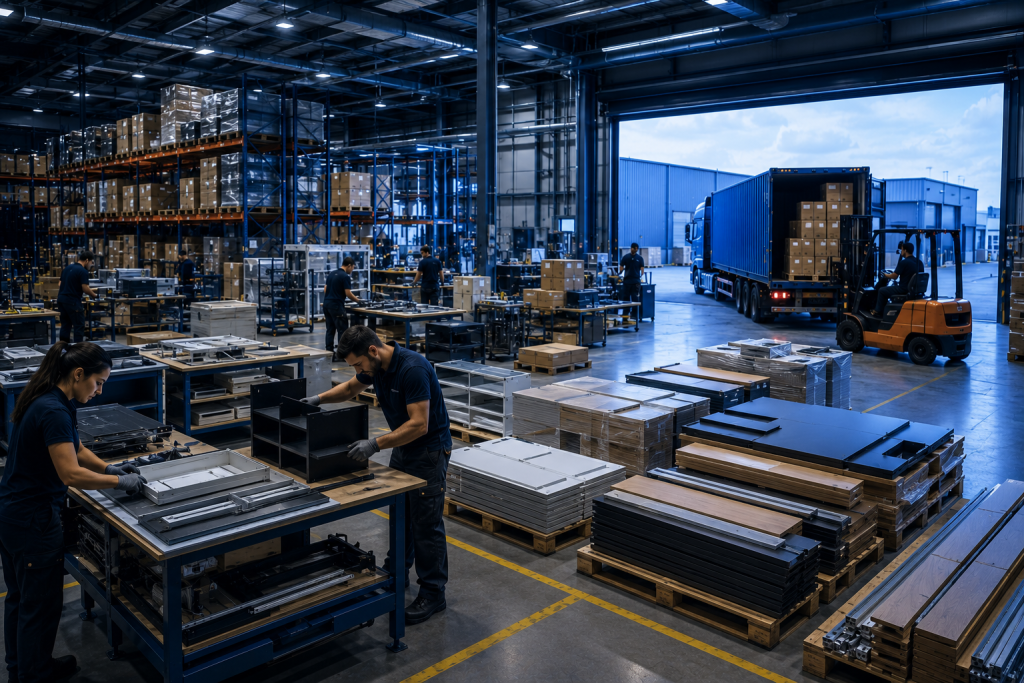
Retail Manufacturers and Suppliers Supporting Projects Worldwide
Professional retail manufacturers and suppliers form the production and supply network behind almost every physical retail environment. Before fixtures can be installed, stores opened, displays updated or international rollout programmes completed, businesses need companies capable of designing, manufacturing and supplying the equipment, materials and technology required to turn a retail concept into reality.

The sector extends far beyond traditional shopfitting manufacture. Modern retail projects can involve bespoke furniture, shelving systems, counters, display equipment, signage, lighting, digital technology, point-of-sale systems, merchandising equipment, specialist materials, packaging and numerous other components. A single store environment may therefore depend on several manufacturers and suppliers working alongside designers, project managers, logistics providers and installation companies.
As retail brands expand internationally, the supply network becomes increasingly global. Components may be designed in one country, manufactured in another and installed across several different markets. This creates opportunities for manufacturers capable of supporting international programmes, but it also increases the importance of communication, quality control, logistics planning and consistent production standards.
The Global Retail Directory brings manufacturers and suppliers into the same international B2B network as retailers, brands, retail installation companies and transport and logistics providers, helping businesses discover potential partners across the wider global retail industry.
The Role of Manufacturing in Modern Retail
Retail manufacturing transforms design concepts into the physical components customers eventually encounter inside stores. The quality of this process has a direct influence on the appearance, durability and functionality of the finished retail environment.
Manufacturers may work from architectural drawings, technical specifications, prototypes or established brand standards. Depending on the project, production can range from a single bespoke fixture for a flagship location to thousands of identical units required for an international rollout.
Large programmes require particularly strong production control. Small manufacturing inconsistencies that might be relatively insignificant on an individual fixture can become major problems when repeated across hundreds of units. Dimensions, materials, finishes, fixing points and component identification therefore need to remain consistent throughout production.
Manufacturers also need to consider what happens after products leave the factory. Fixtures must survive transportation, reach the correct locations and be practical for installation teams to assemble on site. Successful retail manufacturing therefore connects production with logistics and installation rather than treating them as completely separate stages.
Retail Fixtures and Display Manufacturing
Fixtures and displays remain among the most visible products supplied to the retail industry. Shelving systems, wall displays, counters, freestanding units, promotional fixtures and branded merchandising equipment all influence how products are presented to customers.
Different retail sectors create very different manufacturing requirements. Luxury environments may require highly detailed finishes and bespoke materials, while supermarket and convenience-store equipment may prioritise durability, repeatability and efficient installation. Technology retailers may require fixtures incorporating power, cable management and digital displays.
The manufacturer needs to understand these practical requirements alongside the visual design.
For rollout projects, modular construction can provide significant advantages. Fixtures designed as repeatable components can simplify manufacturing, transportation, installation and future maintenance. Individual damaged components may also be easier to replace without removing an entire fixture.
The relationship between manufacturer and installer is particularly important at this stage. Practical installation feedback can identify assembly difficulties, packaging problems or opportunities to improve future versions of a product.
Signage and Visual Communication Suppliers
Signage forms another major part of the global retail supply chain.
External signs, internal navigation, illuminated displays, promotional graphics, wayfinding systems and branded visual elements all contribute to the identity and functionality of retail environments. These products can involve specialist manufacturing processes and materials depending on their intended location and lifespan.
International programmes introduce additional considerations. Language, local regulations, electrical standards and physical store layouts may differ between countries, even when the overall brand identity remains consistent.
Accurate production information is therefore essential. Incorrect dimensions, colours or specifications can create significant delays when installation teams are already scheduled to attend a location.
Packaging and identification also matter. Large programmes may contain hundreds of similar-looking signs intended for different stores. Clear labelling helps warehouses, transport providers and installation teams maintain control throughout the supply chain.
Digital Technology and Retail Equipment Suppliers
Technology is now integrated throughout modern retail.
Commercial displays, interactive systems, electronic shelf labels, digital signage, sensors, payment technology and connected equipment are increasingly common across stores and commercial environments. This has created an expanding network of technology manufacturers, distributors and specialist suppliers supporting the retail sector.
Supplying technology into a retail project requires more than delivering equipment. Compatibility, mounting requirements, power provision, connectivity and software configuration can all influence how successfully the product is integrated into the store.
Suppliers should therefore provide clear technical information to project managers and installation teams. Equipment dimensions, fixing arrangements, connection requirements and configuration instructions can significantly reduce problems during deployment.
For large-scale programmes, replacement availability and ongoing technical support are also important. Retail technology may remain operational for many years after the original installation, creating a continuing relationship between retailers and their equipment suppliers.
Manufacturing for Multi-Site Retail Rollouts
Multi-site rollout programmes place substantial demands on retail manufacturers and suppliers.
Production needs to align with the installation programme so that sufficient equipment is available without creating unnecessary storage requirements. Manufacturing too slowly can delay installations, while producing everything too early may create pressure on warehouse capacity and working capital.
Phased production can provide a practical solution. Equipment is manufactured in batches aligned with scheduled geographical or programme phases, allowing logistics providers and installation teams to work through the rollout progressively.
However, this approach requires reliable forecasting and communication. Changes to store schedules can affect manufacturing priorities, warehouse allocations and transport plans.
Quality control becomes equally important. If a manufacturing problem is identified during early installations, the information should reach the production team quickly enough to prevent the same issue being repeated across subsequent batches.
This continuous feedback between installation, project management and manufacturing can significantly improve the efficiency of a large rollout.
Packaging Retail Fixtures for Transport and Installation
Packaging is sometimes treated as a minor consideration compared with manufacturing, but for retail projects it can have a major impact on the final result.
A beautifully manufactured fixture provides little value if it arrives damaged. Packaging therefore needs to protect surfaces, corners, glass, technology and other vulnerable components throughout warehousing, transportation and final handling.
At the same time, excessive or poorly designed packaging can create difficulties for installation teams. Large quantities of unnecessary material take time to remove and generate waste at retail locations where disposal facilities may be limited.
Good packaging balances protection with practicality.
Component identification should also form part of the packaging strategy. Installation teams working overnight or under restricted time windows need to identify parts quickly. Clearly labelled boxes and logical packing sequences can reduce installation time and minimise mistakes.
For international shipping, packaging may also need to withstand longer journeys, multiple handling stages and different environmental conditions.
Connecting Manufacturers with Transport and Logistics Providers
Once production is complete, responsibility begins moving into the logistics network.
Manufacturers and transport providers therefore need accurate communication about dimensions, weights, collection requirements and delivery schedules. Bespoke retail equipment can require different handling from conventional freight, particularly where components are oversized, fragile or high value.
For international programmes, products may travel through several logistics stages before reaching the final store. Factory collection, consolidation, international freight, regional warehousing and final-mile delivery can all involve different providers.
Good planning reduces unnecessary handling and helps ensure equipment reaches installation teams in suitable condition.
This connection between manufacturing and logistics is a fundamental part of the Global Retail Directory model. Businesses operating in both sectors can be discovered within the same platform, making it easier for project teams to build complete supply networks.
Connecting Manufacturers with Retail Installation Companies
Installation teams provide manufacturers with one of the most valuable sources of practical feedback.
They see how products perform outside the controlled factory environment. They encounter real walls, floors, access restrictions, existing fixtures and differences between store layouts. They also experience how easily components can be identified, assembled, adjusted and fixed.
Strong manufacturers recognise the value of this information.
If several installation teams report the same difficulty, changing a component or assembly method may save significant time across the remainder of a rollout. Similarly, improved installation instructions or better labelling can resolve problems without changing the manufactured product itself.
Manufacturers and installers should therefore be considered partners within the delivery process rather than isolated businesses operating at opposite ends of the project.
The Global Retail Directory is designed to make these industry connections easier by bringing specialist companies together through one worldwide platform.
Sustainability and Responsible Retail Manufacturing
Sustainability is becoming increasingly important across retail manufacturing and supply chains.
Retailers and brands are paying greater attention to material selection, manufacturing processes, packaging, transportation and the future reuse or recycling of fixtures. Durable products that can be repaired, reconfigured or updated may provide advantages over equipment designed for short-term replacement.
Modular manufacturing can also support sustainability by allowing individual components to be changed rather than replacing complete installations.
Packaging presents another opportunity. Reducing unnecessary materials while maintaining adequate product protection can lower waste across large rollout programmes.
Transportation should also be considered during product design. Fixtures that can be packed efficiently may require fewer vehicle movements, reducing both logistics costs and environmental impact.
Sustainability therefore increasingly connects manufacturers, suppliers, logistics providers, installation companies and retailers throughout the complete project lifecycle.
Choosing Retail Manufacturers and Suppliers
Selecting the right manufacturing or supply partner depends on much more than unit price.
Businesses may need to consider production capacity, quality-control systems, materials expertise, technical capabilities, geographical location, lead times and experience with similar retail programmes.
A manufacturer capable of producing ten bespoke units may not necessarily have the infrastructure required to manufacture several thousand within a controlled rollout schedule. Equally, highly specialised manufacturers can provide capabilities that larger general suppliers cannot easily reproduce.
Communication is another important consideration. Retail projects change, and suppliers need processes capable of managing revisions without losing control of specifications.
For international programmes, experience with export requirements and global logistics can provide additional value.
The right partner is therefore the company whose capabilities match the specific commercial, technical and geographical requirements of the project.
Building a Worldwide Retail Manufacturing and Supply Network
The international retail industry depends on thousands of specialist businesses whose work is often invisible once the finished store opens.
Manufacturers produce the fixtures, suppliers provide equipment and technology, logistics companies move the components, installation teams assemble them and retailers and brands bring everything together for the customer.
Finding the right companies across this fragmented global market can be challenging.
The Global Retail Directory provides a dedicated international platform connecting manufacturers and suppliers with retail installation companies, transport and logistics providers, retailers, brands, project managers and other industry professionals.
The Manufacturers and Suppliers category gives businesses a place to present their capabilities, products and services to organisations searching for retail industry partners around the world.
For retailers and project teams, it provides another route to discovering manufacturers and specialist suppliers capable of supporting individual projects, national programmes and international rollouts.
For manufacturers and suppliers themselves, joining the Global Retail Directory creates an opportunity to increase worldwide visibility and become part of a growing professional network connecting the businesses that design, manufacture, transport, install and operate the modern global retail environment.