
Retail Industry in the Netherlands
The retail industry in the Netherlands combines a sophisticated consumer market with one of Europe’s most important logistics networks, internationally recognised brands, advanced agriculture, food production, technology and a strong manufacturing and supplier base. Amsterdam provides the country with its most internationally visible retail environment, while Rotterdam connects Dutch commerce with one of the world’s great ports. Utrecht, The Hague, Eindhoven and other cities add substantial regional markets and specialist economic strengths within a remarkably compact country.

The Netherlands is particularly interesting because its importance to retail is much larger than its domestic population alone would suggest. Products arriving from international manufacturers can enter Europe through Dutch ports and logistics facilities before continuing toward warehouses, stores and consumers across several countries. Dutch businesses operate internationally in fashion, food, consumer products, technology and other sectors, while manufacturers and specialist suppliers can use the country’s central European position to reach customers far beyond the national market.
For the Global Retail Directory, the Netherlands demonstrates how closely Retail Installation Companies, Manufacturers & Suppliers, Transport & Logistics businesses and Iconic Brands can interact. Retail is not simply what happens in Amsterdam shopping streets or Dutch shopping centres. It begins with products and materials, continues through ports and warehouses, reaches physical and digital stores and can eventually connect Dutch businesses with customers throughout Europe and the wider world.
Amsterdam Combines International Retail with a Distinctive Urban Environment
Amsterdam provides the Netherlands with its most internationally recognised retail destination. International fashion and luxury brands operate alongside Dutch retailers, department stores, specialist boutiques, food businesses and neighbourhood commerce, while tourism introduces the city’s stores to customers from around the world. Different districts create very different commercial environments, allowing global brands and independent businesses to operate within the same relatively compact city.
The historic urban environment also creates practical challenges for physical retail. Narrow streets, older buildings, restricted access and limited back-of-house space can make deliveries and installation considerably more complicated than they would be within a purpose-built suburban development. Fixtures may need modular construction, delivery schedules can require careful coordination and site surveys need to consider how equipment will physically move from the vehicle to its final position.
For Retail Installation Companies, this creates demand for much more than basic assembly. International brands need teams capable of protecting global design standards while adapting the delivery process to Dutch buildings and access conditions. A beautifully manufactured counter still fails commercially if it cannot reach the store, making installation planning part of the design and manufacturing process rather than simply the final stage.
Rotterdam Connects Dutch Retail with Global Supply Chains
Rotterdam gives the Netherlands an international commercial role far greater than the size of the country might suggest. The city and surrounding region form one of Europe’s most important maritime and industrial gateways, connecting international shipping with road, rail, inland waterways, warehouses and distribution networks extending deep into the continent.
For retail, this infrastructure is largely invisible to the customer but fundamental to product availability. Consumer electronics, furniture, clothing, food, machinery, packaging and commercial equipment can arrive from manufacturing regions around the world before entering European distribution networks. Some goods remain in Dutch warehouses, while others continue toward Germany, Belgium, France and markets considerably farther away.
This makes Transport & Logistics central to the Dutch retail story. Freight forwarding, customs processes, warehousing, container movements and regional distribution connect manufacturers with retailers across Europe. The Netherlands is therefore not simply a place where products are consumed; it is one of the places through which international retail supply chains enter and move across the European market.
The Netherlands Functions as a European Distribution Platform
The country’s geographic position gives retailers and manufacturers access to several major European consumer markets within relatively short distances. Belgium and Germany are immediate neighbours, while France, Luxembourg and other markets can be reached through established European road and rail networks. This makes the Netherlands particularly attractive for companies seeking one distribution base capable of supporting several countries.
Warehousing consequently plays a strategic role. Modern facilities can receive international products, inspect inventory, fulfil e-commerce orders, replenish stores and process returns. A warehouse serving multiple markets needs accurate systems because products can be allocated across countries, customers and channels rather than simply being stored until required.
For international manufacturers, a Dutch logistics base can provide a route into Europe without requiring separate inventory facilities within every destination. For retailers, strategically positioned stock can balance delivery speed against property and inventory cost. GRD can help connect these companies with Dutch logistics providers whose capabilities extend far beyond conventional transportation.
Dutch Shopping Streets and Centres Support Different Retail Formats
The Netherlands contains a strong network of regional cities rather than depending entirely on one enormous metropolitan centre. Amsterdam attracts international attention, but Rotterdam, Utrecht, The Hague, Eindhoven, Groningen and other cities support substantial retail markets with their own customer profiles and commercial identities.
Physical formats vary accordingly. Historic city centres support pedestrian shopping streets and compact units, while suburban areas can accommodate shopping centres, supermarkets, furniture retailers and larger commercial formats. Retailers expanding nationally therefore need enough flexibility to adapt a recognisable concept to properties that can differ considerably in age, size and access.
This variation creates continuing opportunities for manufacturers and installation businesses. Furniture may need standardisation across a rollout while individual stores require site-specific adaptations, and refurbishment can involve working within operating locations where closure time needs to remain minimal. Dutch retail therefore combines the efficiency of a compact national market with the practical complexity of a diverse property estate.
Eindhoven Connects Technology and Manufacturing with Retail
Eindhoven and the surrounding region provide another important part of the Dutch commercial economy through their strong association with technology, engineering and advanced industry. These capabilities may appear separate from conventional retail, but modern stores increasingly depend on electronics, screens, sensors, connected systems and digital infrastructure.
A contemporary display can combine furniture, metalwork, lighting, screens, power and connectivity within one product. Warehouses similarly depend on scanning, inventory technology and automation, while retailers use digital systems to connect physical stores with online operations. Businesses capable of engineering these components therefore contribute to retail even when consumer-facing stores represent only one part of their customer base.
For GRD’s Manufacturers & Suppliers category, this demonstrates why industry boundaries should remain broad. An engineering or technology business does not need to describe itself as a retail company to provide something highly valuable to retailers. What matters is whether its capabilities can solve a commercial requirement, and the Netherlands contains substantial technical expertise capable of doing exactly that.
Dutch Agriculture and Horticulture Connect Production with Global Retail
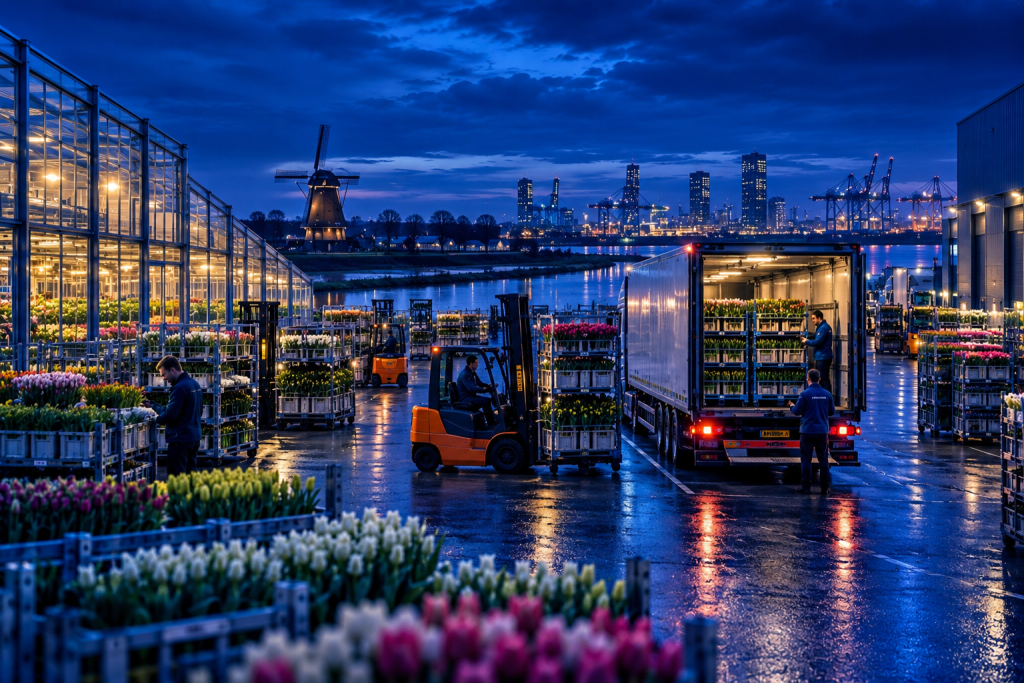
The Netherlands has an unusually important agricultural and horticultural sector relative to its geographic size. Flowers, plants, vegetables, dairy products and other goods move through highly organised production and distribution systems serving domestic and international customers, connecting farms and specialist producers directly with supermarkets, garden retailers, florists and other consumer channels.
Flowers provide a particularly distinctive example. Fresh products need efficient handling because time directly influences their retail value. Production, sorting, packaging, temperature management, transportation and final distribution all need to operate within a coordinated system. A bouquet appearing inside a supermarket in another European country can therefore depend on Dutch infrastructure even when the customer knows little about the network behind it.
This demonstrates why retail begins long before the product reaches the shelf. Agricultural producers, packaging businesses, logistics companies and retailers participate in one continuous commercial chain. For Global Retail Directory, these businesses belong naturally within the wider retail ecosystem because their combined capabilities determine whether a perishable product reaches the customer in commercially acceptable condition.
Dutch Food Production Can Become International Consumer Brands
Food and beverage manufacturing provides another connection between Dutch production and international retail. Dairy, confectionery, snacks, beverages, speciality foods and numerous other products can move from manufacturing facilities into supermarkets and hospitality markets throughout Europe and beyond.
Turning production capability into a successful consumer brand requires considerably more than manufacturing. Packaging needs to protect the product and communicate effectively, retailers need reliable supply and distribution must preserve quality throughout the journey. International expansion can introduce additional requirements around labelling, regulations and product formats according to the destination market.
For Dutch Iconic Brands, the country’s logistics position can provide an advantage because international distribution is already deeply integrated into the wider economy. A domestic consumer business can use e-commerce, wholesale and retail partnerships to reach neighbouring markets before establishing permanent stores of its own, allowing international growth to develop gradually rather than requiring enormous investment from the beginning.
Dutch Brands Can Build International Networks from a Small Home Market
The Netherlands demonstrates that a company does not need an enormous domestic population to develop internationally recognised consumer brands. A relatively compact home market can encourage ambitious businesses to think internationally earlier because meaningful long-term growth may eventually require customers outside national borders.
International expansion creates a much larger B2B network around the brand. A Dutch retailer opening stores elsewhere in Europe needs property specialists, furniture, logistics, installation and maintenance within each destination. Some components may continue to be manufactured centrally, while other requirements are better sourced locally according to availability and project economics.
This is where Iconic Brands connect with the other GRD categories. The consumer sees one Dutch company, but behind an international store network can sit manufacturers, logistics providers and installation businesses from several countries. Brand growth therefore creates commercial opportunities extending far beyond the organisation whose name appears above the store entrance.
E-Commerce Makes Dutch Logistics Even More Important
The Netherlands is particularly well positioned for e-commerce because its dense population, compact geography and European connectivity allow products to move efficiently between warehouses and consumers. Digital purchasing nevertheless depends entirely on physical infrastructure after the customer presses the order button.
Inventory needs to be stored accurately, individual orders need picking and packing, parcels require transportation and returns need processing. When the same fulfilment centre serves several European markets, these systems become more complex because inventory may need to satisfy customers operating under different delivery expectations and commercial conditions.
Physical stores can also participate through collection, returns and local stock, reducing the distinction between conventional retail and fulfilment. This creates opportunities for warehouse operators, packaging companies, automation providers and technology businesses, demonstrating again that e-commerce increases demand for sophisticated physical infrastructure rather than replacing it.
Cycling and Compact Cities Influence Dutch Retail Geography
Dutch cities have developed around patterns of movement different from car-dominated suburban markets elsewhere. Walking, cycling and public transport play important roles within many urban centres, affecting the scale and accessibility of commercial properties as well as the way customers interact with shopping districts.
Retailers need to understand these conditions when choosing formats and locations. Large parking-dependent stores may work well in particular suburban environments but make little sense within dense historic centres, while smaller convenience and specialist formats can benefit from frequent pedestrian and cycling traffic.
Deliveries create another consideration because customer-friendly streets are not always simple logistics environments. Retailers still need products, furniture and equipment to reach stores even when vehicle access is restricted. This requires careful scheduling and increasingly efficient urban distribution, giving logistics businesses another specialised role within the Dutch retail ecosystem.
Retail Installation Often Needs to Work Around Active Trading
Mature retail markets create substantial refurbishment activity because existing stores need continual updating as brands change identity, technology and merchandising. Retailers frequently want to minimise closure time, meaning installation can take place overnight, in phases or within tightly controlled periods outside normal trading.
These projects require detailed coordination. Existing fixtures may need removal before new equipment arrives, waste needs to leave the site and installers need confidence that every component required for the shift is present. Discovering missing hardware after dismantling an operating store can create significantly more disruption than finding the same problem within an empty construction site.
Dutch Retail Installation Companies capable of working within these conditions provide value through planning as much as physical labour. Successful refurbishment is often invisible to customers: they leave one evening and return to a transformed environment the following morning without seeing the complex manufacturing, logistics and installation programme behind the change.
Sustainability Is Closely Connected with Dutch Retail Innovation
Sustainability is increasingly important to retailers, property owners and manufacturers across the Netherlands and wider European market. Energy efficiency, packaging, materials, transportation and the lifecycle of store equipment all contribute to the environmental impact of retail operations.
Fixtures provide an opportunity for circular thinking. Structural components can be designed to remain in service while graphics or decorative surfaces change, furniture can be repaired or refinished and modular systems can allow individual damaged components to be replaced rather than discarding complete units. Warehouses can support reuse by storing equipment between projects.
These approaches can also make commercial sense. Manufacturing and transporting replacement equipment costs money, so extending asset life can reduce expenditure as well as waste. Dutch manufacturers and designers capable of combining sustainability with practical engineering can therefore strengthen their position with retailers seeking measurable improvements rather than environmental claims disconnected from day-to-day operations.
International Retailers Need Dutch Partners
The Netherlands is an attractive market for international retailers because of its consumer purchasing power, major cities, international tourism and close connection with neighbouring European economies. But even within a relatively compact country, international concepts need local execution.
Historic buildings, shopping-centre regulations, urban delivery restrictions and Dutch technical requirements can all influence how a store is delivered. Imported equipment still needs warehousing and installation, while ongoing maintenance requires local capability after the original opening team has finished.
International brands therefore benefit from relationships with Dutch manufacturers, logistics companies and Retail Installation Companies capable of working within their standards. Local expertise does not mean compromising a global concept; it allows that concept to function reliably within the actual buildings and commercial conditions of the destination market.
Rotterdam and Amsterdam Connect Europe with International Suppliers
The Netherlands can also provide overseas manufacturers with an effective entry point into the European retail industry. A supplier in Asia, North America or another region may use Dutch logistics infrastructure to import equipment or products before distributing them toward customers across several European countries.
This requires more than shipping containers to a port. Products need appropriate documentation, warehousing, inventory management and onward transportation, while commercial equipment can require inspection or consolidation before being allocated to individual store projects.
For international Manufacturers & Suppliers, establishing relationships with Dutch logistics and project businesses can therefore create a practical European operating network without immediately building permanent infrastructure in every country. GRD can help make those relationships easier to establish by connecting capabilities across national and sector boundaries.
Connecting Dutch Businesses Through Global Retail Directory
The Netherlands contains businesses relevant to almost every part of the international retail ecosystem. Logistics companies connect global shipping with European distribution, technology and engineering businesses support increasingly sophisticated stores, manufacturers produce specialist commercial products and Dutch brands operate within domestic and international consumer markets.
The Global Retail Directory is designed to make these capabilities easier to discover. Dutch Retail Installation Companies can demonstrate where they operate, Manufacturers & Suppliers can present specialist production capabilities, Transport & Logistics businesses can connect with international retailers and manufacturers, and Iconic Brands can represent the consumer businesses whose growth generates opportunities throughout the wider industry.
The same system works in both directions. An overseas retailer entering the Netherlands can discover local partners, while a Dutch manufacturer or specialist supplier can become visible to project organisations elsewhere. The objective is to connect businesses according to capability and commercial relevance rather than allowing valuable relationships to remain hidden inside local networks.
The Netherlands Is a Retail Gateway Far Larger Than Its Domestic Market
The future of the retail industry in the Netherlands will continue to be influenced by digital commerce, technology, sustainability, changing consumer behaviour and the evolution of physical stores. Amsterdam will remain the country’s most internationally visible retail destination, while Rotterdam’s logistics infrastructure, Eindhoven’s technology economy and regional cities provide additional strengths extending well beyond conventional consumer commerce.
The country’s greatest retail advantage may be the way these capabilities connect. International products can arrive through Dutch ports, move into sophisticated logistics networks and continue toward consumers throughout Europe. Dutch manufacturers and food producers can use the same infrastructure in reverse, while domestic brands can build international networks from a relatively small but highly connected home market.
For Global Retail Directory, the Netherlands therefore represents exactly the type of economy where the GRD mix becomes particularly visible. Retailers need manufacturers, manufacturers need logistics, stores need installation and maintenance, and growing brands need partners when they move into new countries. The Netherlands may be geographically compact, but its role within European and global retail is anything but small.