
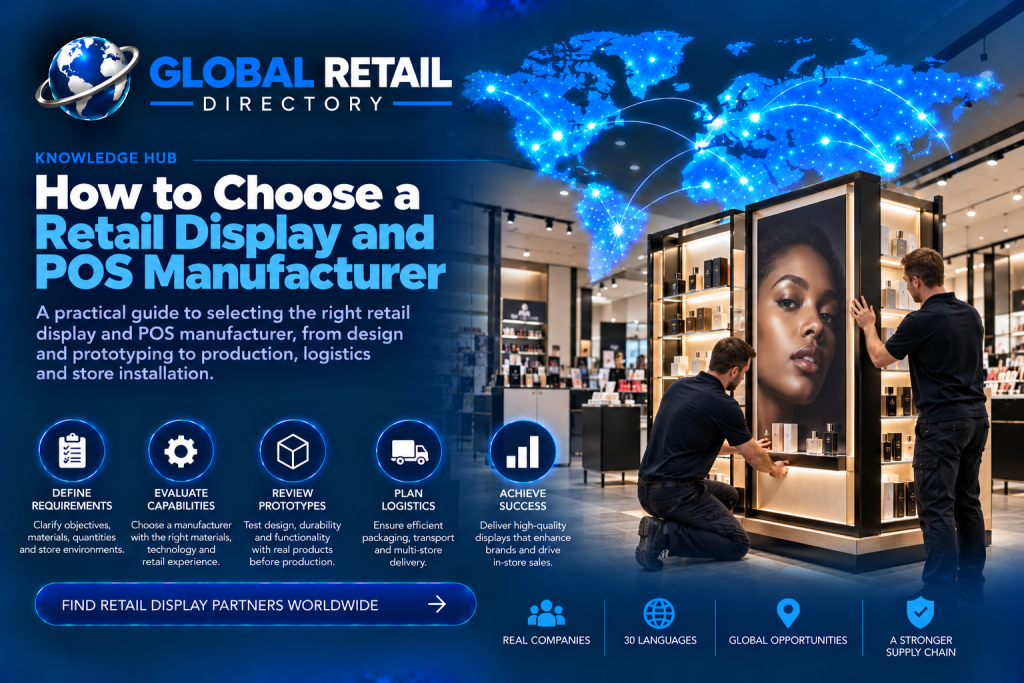
How to Choose a Retail Display and POS Manufacturer
Choosing the right retail display and POS manufacturer can have a direct influence on how successfully products are presented inside stores. Permanent displays, promotional units, branded furniture, freestanding display units, counter displays and interactive product environments all need to combine visual impact with durability, manufacturability, logistics and practical installation.

Retail displays can appear relatively simple when viewed by customers, but the manufacturing process can involve timber, metal, plastics, acrylic, glass, graphics, lighting and digital technology within one finished unit. A manufacturer therefore needs more than the ability to produce an attractive prototype. It needs the systems and production capability required to reproduce the design consistently across the complete retail programme.
The right supplier depends on the type of display, expected quantities, materials, programme length and markets in which the equipment will eventually be installed. Buyers should evaluate manufacturing capability, prototypes, quality control, packaging, logistics and installation before committing to volume production rather than selecting a supplier primarily according to factory price.
Define Exactly What the Retail Display Needs to Achieve
Every display project should begin with a clear commercial objective. Some displays are designed to introduce a new product, others increase visibility within an established category, while permanent branded fixtures can remain inside stores for several years. Understanding the purpose determines how much should be invested in materials, construction and technology.
The merchandise itself also influences the design. Heavy products require stronger structures, valuable products may require security and electronic devices can need power, cable management or ventilation. Displays containing products customers handle repeatedly need different durability from units primarily intended to communicate brand information.
Buyers should therefore provide manufacturers with more than visual concepts. Product weights, merchandising quantities, expected lifespan, store environment and customer interaction should all form part of the specification. A manufacturer can make much better technical decisions when it understands what the display needs to accomplish commercially.
Understand Permanent, Semi-Permanent and Temporary Displays
Retail displays can be divided broadly according to how long they are expected to remain in stores. Permanent fixtures can operate for several years and normally justify more durable materials, stronger construction and components that can be repaired or replaced during their working life.
Semi-permanent displays may support a product category or campaign for several months. They still need professional construction but can use lighter materials and simpler assembly because their expected lifecycle is shorter. Cost, freight efficiency and speed of production often become particularly important for these programmes.
Temporary POS displays can be designed around short promotional periods, product launches or seasonal campaigns. Cardboard and lightweight materials may be entirely appropriate when the equipment only needs to remain operational for weeks. Buyers should match manufacturing quality with realistic lifespan rather than over-engineering temporary equipment or under-specifying fixtures expected to survive years of commercial use.
Choose a Manufacturer with the Right Material Capabilities
Retail displays frequently combine several materials, and different manufacturers develop strengths around particular production processes. Timber and board products can require CNC machining, laminating and finishing, while metal structures involve cutting, bending, welding and powder coating. Acrylic, plastics and glass introduce additional specialist processes.
A manufacturer does not necessarily need to perform every process internally. Many successful display companies maintain established networks of specialist subcontractors, particularly for graphics, lighting, plastics and unusual finishes. What matters is whether the principal manufacturer can control these processes consistently and take responsibility for the complete finished product.
Buyers should therefore evaluate the supplier against the actual display specification. A large factory with impressive machinery is not automatically more suitable than a specialist manufacturer experienced in the exact combination of materials required. Capability should be measured against the project rather than factory size alone.
Evaluate the Manufacturer’s Retail Experience
Retail manufacturing has requirements that differ from many conventional manufacturing sectors. Equipment can need to arrive at hundreds of stores within narrow installation windows, while every unit must look consistent because customers experience the finished display as part of one brand.
Manufacturers with retail experience are more likely to understand component identification, rollout schedules, packaging and the importance of replacement parts. They can also understand why a small visual defect that might be acceptable on industrial equipment can be unacceptable on a customer-facing premium display.
Previous work should be evaluated according to technical relevance rather than famous brand names alone. A manufacturer that has successfully delivered several large multi-store programmes using comparable materials may be more appropriate than a prestigious supplier whose previous work involved completely different production requirements.
Prepare Accurate Technical Drawings and Specifications
Concept artwork communicates the intended appearance of a display but rarely contains enough information for reliable manufacturing. Technical drawings should define dimensions, materials, construction, hardware, tolerances and the relationship between individual components.
Displays incorporating products require particularly accurate information. Shelves need to support the correct weight, product holders need appropriate dimensions and graphics need to align with the merchandise. Digital equipment can introduce requirements for ventilation, cabling and access that need to be incorporated into the structure.
Approved drawings should become the manufacturing reference throughout the programme. Changes need controlled revision numbers so factories, designers and installation teams understand which version is current. This prevents outdated information from continuing into production after a design has already changed.
Develop a Prototype Before Volume Production
Prototyping allows the retailer and manufacturer to transform drawings into a physical product before large quantities are produced. The display can be assembled, merchandised and evaluated under realistic conditions, revealing issues that can be difficult to identify through drawings alone.
Product interaction should be tested carefully. Customers need to reach merchandise comfortably, shelves should remain stable and graphics should remain visible when the display is fully stocked. Lighting and digital technology should also be assessed as part of the complete unit rather than separately.
The prototype should use materials and production methods representative of final manufacturing. Once approved, it can become a physical quality reference for production units and provide installation teams with an opportunity to understand assembly before live rollout begins.
Test the Display with Real Products
An empty display can appear completely different after merchandise has been added. Products can obscure graphics, shelves can become visually overcrowded and weight distribution can change how the structure behaves.
Testing should therefore use the actual products or accurate equivalents whenever possible. Merchandising teams can evaluate capacity and customer accessibility while engineers confirm that shelves, hooks and supports perform correctly under realistic loads.
This process can also reveal opportunities to simplify the display. Unnecessary shelves, excessive product capacity or complicated adjustable components can add manufacturing cost without improving sales presentation. Testing with real merchandise keeps development focused on the commercial purpose of the fixture.
Consider Graphics as Part of the Manufacturing System
Graphics are central to many POS displays because they communicate the brand, product benefits and promotional message. They should therefore be integrated into the design rather than treated as an element added after manufacturing has finished.
Different graphic technologies suit different applications. Printed boards, vinyl, fabric, acrylic panels and illuminated graphics all have different durability, appearance and replacement requirements. Temporary campaigns may prioritise low-cost replacement, while permanent displays can require more durable solutions.
Replaceable graphics can extend the useful life of the underlying structure. A retailer can update campaigns or products without discarding the entire display, reducing both programme cost and material waste. Manufacturers should therefore consider how graphics will be fitted, changed and transported throughout the display lifecycle.
Integrate Lighting and Technology Correctly
Lighting can significantly influence how merchandise appears and can become an important part of premium displays. LEDs, illuminated logos and product-specific lighting can create visual impact while allowing the display to stand out within a busy store environment.
Technology introduces additional engineering requirements. Screens, interactive devices and electronic products can require power, data connectivity, ventilation and secure mounting. Technicians also need access after installation because equipment will eventually require maintenance or replacement.
These requirements should be resolved during design rather than after furniture has been manufactured. A beautiful display that needs to be dismantled completely every time a screen fails will create unnecessary operational cost throughout the rollout.
Check Electrical and Destination-Market Compliance
Displays containing electrical equipment need to comply with the requirements of the markets where they will eventually operate. Voltage, plugs, wiring, power supplies and certification can vary between countries, particularly during international rollouts.
The manufacturer and buyer should establish clearly who is responsible for electrical components and compliance documentation. Approved components can sometimes be sourced centrally, while other programmes use market-specific electrical kits installed before final delivery.
Safety can also extend beyond electrical systems. Structural stability, glass, materials and fire requirements can be influenced by retailers, landlords or local regulations. Understanding these requirements before production reduces the risk of completed displays being rejected at destination.
Verify Production Capacity Before Placing a Large Order
Producing one excellent prototype does not prove that a manufacturer can deliver hundreds or thousands of units within the required programme. Buyers need to understand normal production capacity, existing workload and how the factory plans to scale when rollout quantities increase.
Production planning becomes particularly important when displays contain several subcontracted components. A furniture factory may have sufficient internal capacity while specialist acrylic, graphics or lighting suppliers create the actual programme bottleneck.
Buyers should discuss realistic weekly output rather than relying only on a final completion date. Understanding how production will ramp up provides much better visibility and allows quality-control inspections and logistics to be planned around actual manufacturing progress.
Establish Quality-Control Standards Before Production
Quality control should be agreed before volume manufacturing begins. Dimensions, materials, colours, finishes, graphics, lighting and functional components can all form part of an inspection checklist linked directly to the approved drawings and prototype.
First-off production units deserve particular attention because they demonstrate whether the factory has successfully transferred prototype methods into normal manufacturing. Problems discovered during the first few units can normally be corrected without affecting the complete programme.
Large or international projects can also use independent inspection companies when appropriate. Objective reporting provides buyers with additional visibility before equipment leaves the factory and reduces the risk of discovering widespread manufacturing problems only after displays have reached stores.
Design Displays for Efficient Packaging
Packaging should be considered while the display is being engineered because the physical design can have a major effect on transportation cost. Fully assembled fixtures can occupy large volumes, while modular or partially disassembled equipment may use vehicles and containers much more efficiently.
The correct approach depends on installation complexity. Flat-packed displays reduce freight volume but transfer more labour to the destination. Fully assembled units can reduce installation time but require greater transportation space and can be more difficult to move through restricted store access.
Protection is equally important. Decorative surfaces, graphics, glass and lighting can all become damaged during handling. Packaging therefore needs to balance freight efficiency with enough protection to ensure the equipment reaches stores in the condition in which it left the factory.
Create Clear Assembly and Installation Instructions
Retail displays can be installed by different teams across hundreds of locations. The manufacturer cannot assume that every installer has previously assembled the product or has direct access to the design team.
Instructions should identify components, fixing methods, assembly sequence and any electrical connections required. Clear diagrams and photographs can communicate complicated steps more effectively than long written explanations, particularly when programmes operate internationally.
Good documentation improves consistency and reduces installation time. It also becomes valuable later when displays need moving, repairing or dismantling, allowing retailers to manage the equipment throughout its complete lifecycle rather than only during the original rollout.
Plan Logistics Around the Retail Programme
POS displays frequently support launches or promotions with fixed commercial dates. Arriving one week late can therefore make the equipment significantly less valuable even when manufacturing quality is excellent.
Freight planning should work backwards from the required store date. Manufacturing, inspection, international transport, customs, warehousing and final delivery all need realistic time allowances rather than depending on the fastest possible transit schedule.
Large programmes can benefit from regional consolidation facilities where displays are checked and allocated before final store delivery. This creates a controlled point between manufacturing and installation and allows missing or damaged components to be identified before teams arrive at live retail locations.
Coordinate Display Installation with Stores
Retail environments can have restricted access periods, particularly inside shopping centres, department stores, airports and supermarkets. Deliveries and installations may therefore need to happen overnight or during tightly controlled working windows.
Display design should reflect these conditions. Complicated assembly can become expensive when labour operates during restricted hours, while large pre-assembled components can create access problems if they cannot pass through goods lifts or store entrances.
Manufacturers, logistics providers and installation companies should therefore share relevant project information. The display is only successful when it reaches the correct location and can be installed efficiently, making final site delivery part of the manufacturing strategy rather than a completely separate activity.
Plan Replacement Parts and Display Maintenance
Permanent and semi-permanent displays can remain in stores long enough for components to become damaged or worn. Lighting can fail, acrylics can scratch and high-contact surfaces can eventually require replacement.
Manufacturers should identify components most likely to need future support and determine whether spare stock should be produced with the original order. Holding common components can be considerably more economical than reopening production for individual replacements months later.
Drawings, finish references and component specifications should also remain available after production. This allows displays to be maintained consistently and can extend their useful life, protecting the retailer’s original investment while reducing unnecessary replacement.
Design for Reuse and Future Campaigns
Retail displays are increasingly being evaluated according to their complete lifecycle rather than one campaign. Structural components can often remain useful while graphics, shelves or product holders change according to future merchandise.
Modular design can make these updates considerably easier. A metal or timber structure can support several campaigns when customer-facing graphics and accessories are designed for replacement rather than permanently integrated into the unit.
This can reduce both cost and waste. Retailers avoid manufacturing complete new displays for every campaign, while manufacturers can develop ongoing relationships supplying updated components and refurbishment rather than depending entirely on new production.
Build Long-Term Relationships with Reliable Display Manufacturers
Once a manufacturer has successfully developed prototypes, established quality standards and completed a rollout, there can be substantial value in maintaining the relationship for future programmes.
Repeat suppliers understand brand expectations, approved materials and common construction methods. Development becomes faster because both businesses already understand how the other operates, while previous installation feedback can improve future display designs.
Businesses should still maintain alternative manufacturing options where appropriate. Strong relationships provide efficiency, while supplier diversification provides resilience. The objective is to create a manufacturing network capable of supporting both routine programmes and unexpected increases in demand.
Use a B2B Directory to Discover Retail Display and POS Manufacturers
Finding specialist display manufacturers can be difficult because relevant capabilities are spread across several industries. Furniture factories, metal fabricators, acrylic specialists, graphics businesses and complete POS manufacturers can all potentially contribute to the same project.
General searches may therefore overlook companies whose manufacturing capability is suitable but whose websites use different terminology. A metal manufacturer producing commercial structures may be highly relevant to retail displays without describing itself primarily as a POS supplier.
A specialist B2B directory can improve discovery by allowing buyers to search according to capability, market and geography. This is particularly useful when retailers want to compare manufacturing regions, develop alternative suppliers or identify specialists capable of supporting unusual materials or technologies.
Find Retail Display Manufacturers Through Global Retail Directory
The Global Retail Directory brings together Manufacturers & Suppliers contributing to physical retail, including companies capable of producing furniture, displays, fixtures, graphics and specialist commercial equipment.
Retailers and project organisations can also identify Transport & Logistics businesses capable of moving displays between manufacturing and destination markets, together with Retail Installation Companies responsible for completing the final physical delivery inside stores.
A successful display programme depends on all of these stages working together. The customer sees one finished branded environment, while manufacturers, logistics providers and installation specialists operate behind it. Global Retail Directory is designed to make those capabilities easier to discover internationally and help businesses build the supply networks required to deliver physical retail consistently across different markets.