
Retail Industry in Chile
The retail industry in Chile has developed into one of Latin America’s sophisticated consumer markets, combining modern shopping centres, powerful domestic retail groups, supermarkets, department stores, e-commerce and international brands with an economy strongly connected to global trade. Santiago dominates the commercial landscape, but Chile’s unusual geography creates important regional markets extending thousands of kilometres from the Atacama Desert in the north through the central population centres and towards Patagonia in the south.

Chile is particularly interesting from an international B2B perspective because consumer retail, imports, domestic production, logistics and regional expansion are closely connected. The domestic market is smaller than some of Latin America’s largest economies, yet Chilean retail businesses have developed experience and brands capable of operating beyond the country’s borders. At the same time, imported consumer products, technology and commercial equipment form an important part of the market, making ports, warehouses and international supply chains essential to the way Chilean retail operates.
For the Global Retail Directory, Chile represents a market where retailers and Iconic Brands connect with Manufacturers & Suppliers, Transport & Logistics businesses, technology providers and Retail Installation Companies both domestically and internationally. The country demonstrates particularly clearly that modern retail is not confined to the store: it is a network connecting production, ports, warehouses, digital platforms, physical environments and customers across an unusually long national territory.
Santiago Is the Centre of Chilean Retail
Santiago is the natural starting point for understanding the retail industry in Chile. The capital and its wider metropolitan area contain a substantial proportion of the country’s population, corporate headquarters and consumer spending, creating the largest concentration of stores, shopping centres and commercial development. Premium districts accommodate international fashion and luxury brands, while major shopping destinations combine department stores, supermarkets, restaurants, entertainment and specialist retail with extensive neighbourhood commerce throughout the wider city.
The economic importance of Santiago means many international retailers establish their first significant Chilean presence there, while manufacturers and overseas suppliers can use relationships developed in the capital as a route into the wider national market. Santiago also concentrates corporate decision-making, property expertise and professional services, meaning relationships established with retailers or project organisations can potentially lead to work across store networks extending far beyond the metropolitan region.
Physical delivery nevertheless depends on the individual property. Traffic, dense urban development, loading restrictions and building configuration can influence how equipment reaches a store, while a modern shopping-centre unit creates very different conditions from an older urban property. For manufacturers and Retail Installation Companies, this means brand concepts can be standardised visually while transportation, component design and installation planning remain specific to the site.
Shopping Centres Have Become Important Urban Destinations
Shopping centres are deeply embedded within Chilean consumer life and frequently operate as much more than collections of stores. Fashion, supermarkets, restaurants, entertainment, services and leisure can exist within the same development, making major centres destinations where customers spend significant periods of time rather than visiting only to complete one transaction. This helps physical retail remain commercially relevant even as digital shopping continues to develop.
For retailers, organised centres provide concentrated customer traffic and established commercial infrastructure, but they also create tightly managed project environments. Store openings and refurbishments need coordination with property management, deliveries can be restricted to designated loading facilities and contractors may have defined working periods. Large equipment needs to travel through service corridors, loading areas and goods lifts before reaching the retail unit, meaning access conditions should influence fixture design long before manufacturing begins.
These requirements create opportunities throughout Chile’s B2B retail industry. Furniture manufacturers, lighting businesses, technology providers, signage companies, logistics specialists and installation teams all contribute to transforming an empty unit into a finished commercial environment. GRD can help brands identify these capabilities within Chile while allowing local companies to demonstrate that their experience extends beyond conventional construction into specialist retail delivery.
Chilean Retail Groups Have Built Influence Beyond Their Home Market
One of the most significant characteristics of Chilean retail is the influence of domestic groups operating across department stores, supermarkets, home improvement, financial services and shopping-centre development. Several Chilean businesses have expanded into other Latin American markets, demonstrating that the country functions not only as a destination for international retailers but also as a source of regional retail expertise and consumer brands.
International expansion changes the operational requirements placed on these companies. A store concept developed in Santiago may eventually need to operate in Peru, Colombia or another market where consumer behaviour, property conditions and supplier networks differ. The retailer needs to preserve a recognisable brand while allowing physical and operational delivery to adapt to local conditions, creating demand for manufacturers and project specialists capable of supporting repeatable concepts across borders.
This is where Iconic Brands connect naturally with the wider Global Retail Directory ecosystem. When a Chilean retailer or brand expands, its growth can create opportunities for furniture manufacturers, designers, logistics providers and installation companies in several countries. A strong supplier relationship established in Chile can potentially travel with the customer, while destination-market businesses provide capabilities that would be inefficient to transport internationally.
Chile’s Extraordinary Geography Makes Logistics Strategically Important
Chile extends along an exceptionally long and narrow section of South America, creating a retail geography fundamentally different from that of compact European markets. Santiago provides the principal corporate and distribution centre, but customers live in cities separated by substantial distances. Antofagasta and other northern markets serve economies influenced heavily by mining, Concepción provides a major commercial centre farther south and Puerto Montt extends the consumer network into a very different southern environment.
This geography makes distribution planning fundamental to national retail. Inventory needs to reach stores reliably, while the same challenge applies to fixtures, replacement parts and maintenance equipment. A missing component discovered during a project thousands of kilometres from the main warehouse can be considerably more expensive to replace than the component itself because labour, travel and opening schedules can all be affected. Accurate packing, identification and pre-installation checking therefore become valuable operational disciplines.
For GRD’s Transport & Logistics businesses, Chile provides a particularly clear example of why logistics is part of retail rather than a separate industry sitting beside it. Warehousing, inventory management, long-distance distribution and project consolidation all influence whether retailers can operate consistently across the country. Companies capable of supporting national networks can become strategically important partners rather than simply transportation providers.
Mining and Regional Economies Create Consumer Markets Beyond Santiago
Chile’s mining industry has an indirect but important relationship with retail, particularly in northern regions where industrial investment, skilled employment and supporting services generate economic activity far from the capital. Communities serving major industrial economies still require housing, food, clothing, healthcare, entertainment and consumer services, meaning retail demand follows employment and investment rather than existing only in the largest population centres.
For national retailers, understanding these economic patterns can influence expansion decisions. A regional city may support substantial commercial demand because of employment and purchasing power even if its population is smaller than that of another market. Store formats, product ranges and inventory requirements can also differ according to local economic conditions, making regional knowledge important when national networks are developed.
B2B suppliers face the same challenge. Companies capable of delivering projects only within Santiago may struggle to support retailers operating nationally, while businesses with reliable regional coverage can become significantly more valuable. Global Retail Directory can help retailers identify Chilean companies according to capability and geographic reach, which becomes particularly important in a country where distance can dramatically affect project economics.
Pacific Trade Connects Chile with Global Retail Supply Chains
Chile’s Pacific coastline provides strong international trade connections, particularly with markets across the Pacific. Ports including San Antonio and Valparaíso play important roles in moving containerised goods between Chile and the wider world, allowing consumer products, technology, materials and commercial equipment to enter the same freight infrastructure supporting the broader national economy.
For retailers, international trade affects both the products appearing on shelves and the equipment used to create stores. A fashion retailer can import finished merchandise, a technology company can receive electronics through international supply chains and specialist furniture or displays may arrive from approved overseas manufacturers. After reaching the port, goods still require customs processing, domestic transport and potentially warehousing before they reach the final store or consumer.
This complete journey matters to international suppliers. Manufacturing the correct product is only the beginning because packaging, documentation and transportation determine whether it arrives in usable condition and on schedule. GRD’s combination of Manufacturers & Suppliers and Transport & Logistics businesses reflects this reality: successful international retail depends on the connection between production and delivery rather than treating them as unrelated activities.
Chilean Manufacturing Has Its Own Retail Strengths
Chile does not have the same industrial profile as manufacturing economies such as Germany, China or India, but that does not make domestic production unimportant to retail. The country has strengths across food and beverages, wine, forestry-related products, wood, paper, chemicals and industries connected with natural resources, while local businesses also produce packaging, furniture and other commercial products relevant to consumer markets.
Packaging alone represents an important retail industry because almost every physical product requires protection, identification and presentation. E-commerce increases these requirements further because products need packaging capable of surviving individual delivery rather than only transportation between factories, warehouses and stores. Forestry and wood-related capabilities can contribute to furniture and interiors, while food and beverage manufacturing creates opportunities for domestic brands and international exports.
Chile’s supplier ecosystem should therefore be evaluated according to the capabilities the country actually possesses rather than compared mechanically with much larger industrial economies. For GRD’s Manufacturers & Supplierscategory, a Chilean packaging company, food manufacturer, furniture producer or specialist commercial supplier can be highly relevant to international buyers even if Chile is not primarily known as a mass-manufacturing destination.
Wine Shows How Chilean Production Can Become International Retail
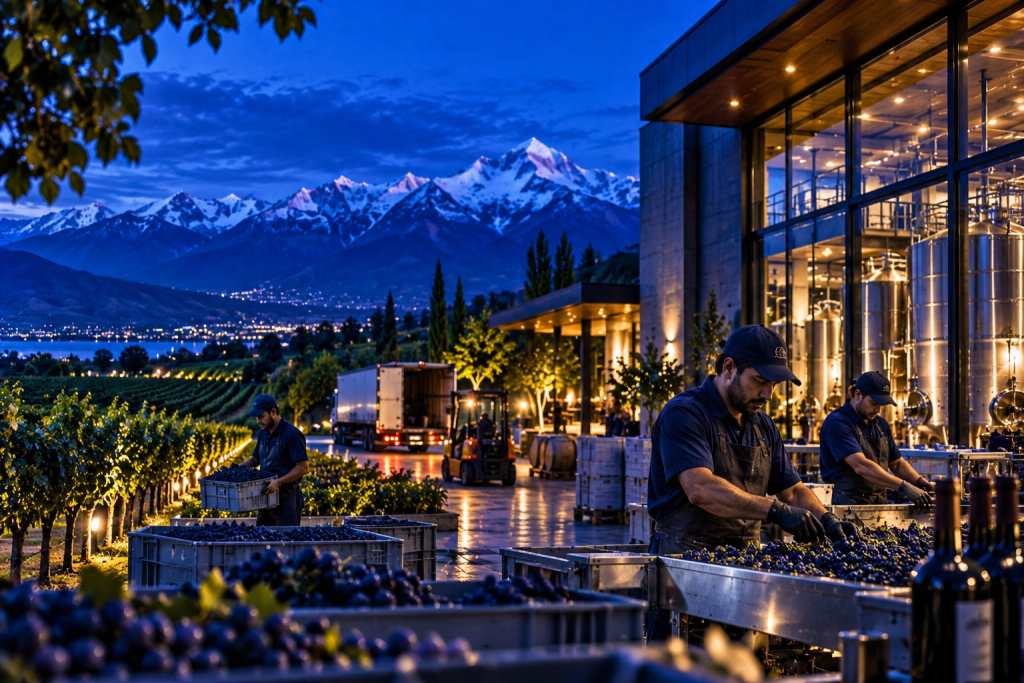
Chile’s wine industry provides a particularly clear example of the relationship between production, branding and international retail. A bottle produced within a Chilean wine region can eventually appear in supermarkets, specialist retailers, restaurants and hospitality environments across numerous countries, connecting agriculture and manufacturing inside Chile with consumers thousands of kilometres away.
The product itself represents only one part of that commercial journey. Bottles, labels, packaging, freight, distribution, marketing and retail presentation all influence whether a wine brand succeeds internationally. Premium producers can also operate visitor centres, shops and hospitality environments that transform production locations into consumer destinations, allowing physical experience to strengthen the brand while creating additional retail opportunities.
The same principle can apply to other Chilean food and consumer businesses. Strong domestic products can use export distribution, tourism and digital commerce to develop international recognition before opening dedicated stores abroad. Within GRD, successful Chilean Iconic Brands can therefore sit at the centre of wider networks involving manufacturers, packaging suppliers, logistics companies and international retail partners.
Physical and Digital Retail Are Becoming One Connected System
Chile’s development of digital commerce does not mean physical stores have lost their relevance. Instead, stores increasingly participate in customer journeys beginning or ending elsewhere. Consumers can research products online before visiting, collect digital orders physically, inspect merchandise before purchasing later through another channel or return an online purchase through a store. The commercial value of the location therefore extends beyond transactions recorded directly at its checkout.
This encourages retailers to think differently about store investment. A physical location can operate simultaneously as a showroom, service centre, collection point, local inventory hub and advertising environment, while technology supports these functions through digital displays, payment systems and connected stock information. Furniture increasingly needs to accommodate power, data and future maintenance access, making technology part of fixture design rather than something added after installation.
E-commerce also raises expectations around fulfilment. Customers want accurate inventory information and dependable delivery, placing pressure on warehouses and distribution operations. Serving Santiago rapidly is very different from delivering thousands of kilometres away, meaning Chilean retailers need strategies balancing delivery speed, inventory cost and regional demand. Digital commerce therefore increases the importance of physical infrastructure rather than eliminating it.
Store Development Must Reflect Chile’s Climate and Physical Environment
Chile contains an extraordinary range of environments, from some of the driest landscapes on Earth in the north through central regions with Mediterranean-style conditions to considerably cooler and wetter areas in the south. Retail materials and equipment need to function across these differences, while heating, cooling and exterior exposure requirements can vary substantially between locations.
Seismic conditions are another important consideration within Chile’s built environment. Shelving, displays and equipment need appropriate engineering and secure installation where movement could create safety risks, while buildings themselves operate within local construction requirements. This demonstrates why international store concepts cannot simply be copied between countries without considering the physical conditions of the destination.
Brand appearance can remain consistent while engineering, materials and installation methods adapt locally. This creates opportunities for Chilean designers, manufacturers and Retail Installation Companies whose understanding of local conditions can help international brands translate global concepts into safe and practical commercial environments. Local expertise becomes part of protecting the international brand standard rather than a departure from it.
Santiago Can Become a Starting Point for Regional Business Relationships
For international companies entering Chile, Santiago provides the largest concentration of retailers, corporate decision-makers and professional services, making it a natural place to establish initial relationships. Those relationships can extend much further because Chilean retail groups operate across Latin America and suppliers proving themselves within Chile can sometimes follow customers as they expand or refurbish locations elsewhere.
The relationship can also work in reverse. An international manufacturer or project company already supporting a retailer in another market may enter Chile alongside the same customer, using an established commercial relationship as the bridge into a new country. Retail partnerships can therefore have value extending well beyond the original project, particularly when suppliers consistently deliver quality and understand the retailer’s operating standards.
For specialist businesses, this means reliability can matter more over time than simply winning the first project at the lowest possible price. GRD can support these relationships by giving Chilean companies international visibility and helping overseas organisations discover local partners, allowing successful connections to develop across multiple markets rather than remaining isolated within one country.
Sustainability Is Becoming Part of Commercial Decision-Making
Chile’s environmental geography makes questions around water, energy, materials and waste particularly visible, while retailers increasingly face sustainability expectations from customers, investors and international partners. Physical stores contribute through lighting, heating and cooling, construction materials, fixtures and packaging, meaning environmental performance increasingly overlaps with commercial operating costs.
Designing equipment for longevity can reduce unnecessary replacement, while modular systems allow retailers to update graphics, panels or surfaces while retaining structural components. Packaging presents another significant opportunity as e-commerce increases the quantity of material moving directly to consumers. Reducing excess packaging and designing products that survive distribution efficiently can lower costs as well as environmental impact.
For manufacturers and suppliers, sustainability is strongest when it becomes part of engineering rather than an additional marketing claim. Better material utilisation, reduced freight and longer-lasting equipment can improve commercial performance at the same time as reducing waste. Chilean businesses capable of demonstrating these practical advantages can strengthen their position with retailers whose procurement decisions increasingly consider the complete lifecycle of products and commercial equipment.
Connecting Chilean Companies Through Global Retail Directory
Chile contains businesses capable of contributing to retail in many different ways, yet international visibility can remain uneven. A retailer entering Santiago may need local companies familiar with commercial projects, an overseas supplier can require a Chilean partner capable of supporting imported equipment and a domestic manufacturer may want to reach retailers elsewhere in Latin America or internationally. These companies can all exist without having an efficient way to discover one another.
The Global Retail Directory is designed around this discovery challenge. Chilean Manufacturers & Suppliers can present their capabilities, Retail Installation Companies can demonstrate the markets they support, Transport & Logistics businesses can connect with companies moving goods through the country and Iconic Brands can represent the consumer-facing businesses whose growth generates opportunities throughout the wider ecosystem.
For Chilean businesses, GRD creates a route toward international visibility without limiting retail to conventional stores. For international buyers, it provides a structured way to discover businesses contributing to Chilean retail and regional supply chains. The country’s combination of consumer markets, Pacific trade, regional distribution, natural-resource industries and domestic brands demonstrates why this broad approach to retail discovery is valuable.
Chile’s Retail Influence Extends Beyond the Size of Its Domestic Market
The future of the retail industry in Chile will be shaped by the continued integration of physical and digital commerce, changing consumer expectations and the country’s strong connections with international markets. Santiago will remain the dominant commercial centre, but regional cities will continue to matter for retailers pursuing national coverage, while Chile’s extraordinary length ensures that distribution and inventory strategy remain central to successful expansion.
Domestic retail groups give Chile commercial influence extending beyond its borders, while ports and international trade connect the market with suppliers and brands throughout the world. Chile also demonstrates that a country does not need one of the world’s largest populations to develop sophisticated retail capabilities. Strong urban markets, international commerce, regional corporate expertise and reliable B2B networks can give a retail economy influence far beyond its physical size.
For Global Retail Directory, those connections create opportunities in both directions. International businesses can discover Chilean suppliers, logistics providers and project partners, while Chilean companies can become visible to retailers and organisations elsewhere. As retail becomes increasingly international, Chile demonstrates the value of connecting brands, manufacturers, technology, logistics and physical retail expertise across borders rather than treating each national market as an isolated commercial system.