
Retail Industry in Poland
The retail industry in Poland occupies an important position within the European economy. Poland is a substantial consumer market in its own right, with large cities, modern shopping centres, extensive grocery networks, developed e-commerce and increasingly sophisticated domestic brands. Its importance to retail, however, extends considerably beyond what happens inside Polish stores because the country has also developed into one of Europe’s significant manufacturing, warehousing and supply locations.

Furniture, metal components, lighting, plastics, packaging, food products, timber products and specialist commercial equipment produced in Poland can ultimately appear inside stores and consumer products throughout Europe. A customer shopping in London, Paris, Berlin or Amsterdam may have no idea that the shelving, furniture, metalwork, packaging or other components surrounding a product originated in a Polish factory. Much of Poland’s contribution to retail therefore remains invisible to the final consumer even though it is commercially important to retailers and brands.
For the Global Retail Directory, Poland demonstrates why understanding retail requires looking behind the storefront. Manufacturers, suppliers, logistics businesses, retail installation companies, technology providers and consumer brands all participate in the same wider ecosystem. Poland’s geographic position, industrial capability and access to European markets make these connections particularly valuable for international buyers searching for reliable partners closer to their customers.
Poland Has Become an Important Part of Europe’s Retail Supply Chain
Poland’s geographic position is one of its fundamental commercial advantages. Germany and major Western European markets sit immediately to the west, while Central and Eastern European economies extend in other directions. Extensive road connections allow Polish factories, warehouses and distribution centres to serve customers across several countries, giving manufacturers access to a consumer region considerably larger than Poland’s domestic market alone and allowing international retailers to build supply networks capable of supporting multiple European markets.
For retailers, proximity influences much more than freight cost. Lead time, flexibility, communication, quality and the ability to correct problems quickly can all affect the true commercial cost of a sourcing decision. A fixture manufactured cheaply thousands of kilometres away can become expensive if an incorrect component delays a store opening, while a manufacturer located closer to the project may be able to produce replacements or modifications considerably faster. European businesses increasingly evaluate supply chains according to overall performance rather than factory price alone, particularly for customised products and time-sensitive retail programmes.
This creates opportunities for Polish companies within GRD’s Manufacturers & Suppliers and Transport & Logistics ecosystem. A manufacturer capable of combining competitive production with reliable European delivery can become particularly valuable to international retailers, while logistics businesses can support programmes extending across multiple countries. Poland’s location therefore becomes commercially powerful when manufacturing, warehousing and distribution operate together rather than as isolated services.
Warsaw and Poland’s Regional Cities Create a Diverse Consumer Market
Warsaw is the centre of Poland’s modern business economy and its largest individual retail market. Major shopping destinations, international brands, supermarkets, premium retail, restaurants, technology businesses and extensive neighbourhood commerce operate throughout the metropolitan area. The city’s importance extends beyond consumer spending because corporate offices, property businesses, developers and international organisations make Warsaw a centre for decisions affecting retail networks throughout the country.
Poland’s retail opportunity is not concentrated entirely in the capital. Kraków, Wrocław, Poznań, Łódź, Gdańsk, Gdynia, Katowice and other cities support substantial consumer markets with different economic identities. Wrocław has attracted significant international business and technology activity, Poznań has strong commercial traditions, Łódź combines industrial heritage with modern redevelopment, and the Tri-City area around Gdańsk, Gdynia and Sopot connects commerce with the Baltic coast. National retailers therefore need regional flexibility rather than assuming that one Polish city provides a template for every other location.
This distributed urban economy also creates opportunities for businesses supporting physical retail. Architects, designers, manufacturers, technology providers and Retail Installation Companies can build relationships with brands operating multiple locations rather than relying on individual projects. A Polish contractor or manufacturer capable of providing consistent national coverage becomes more valuable to retailers as store networks expand, while GRD can help international organisations identify those capabilities when entering the Polish market.
Shopping Centres and Physical Retail Create Continuing B2B Demand
Poland experienced substantial shopping-centre development as its consumer economy expanded, bringing international brands together with domestic retailers, supermarkets, restaurants, cinemas, services and entertainment. Many of these destinations have subsequently evolved beyond their original formats. Newer developments increasingly emphasise food, leisure, architecture and customer experience, while older properties need refurbishment to remain competitive as consumer expectations and brand requirements change.
A shopping centre is therefore never truly finished. Tenants change, stores are refurbished, restaurants open and close, technology is upgraded and common areas need periodic renewal. Every retail unit can require furniture, lighting, flooring, electrical infrastructure, displays, technology and physical installation, while property operators need maintenance and facilities services throughout the life of the development. Mature retail markets can consequently generate substantial recurring B2B activity even when construction of completely new shopping centres slows.
This is particularly relevant to Poland because its domestic manufacturing base allows more of these requirements to be supplied locally or regionally. Polish manufacturers can produce fixtures and components, while installation companies deliver them into stores and maintenance businesses support the environment after opening. Experience gained through Polish projects can then become relevant elsewhere in Europe, particularly when the same international retailer uses similar store concepts across several countries.
Polish Furniture, Metalwork and Lighting Have Global Retail Relevance
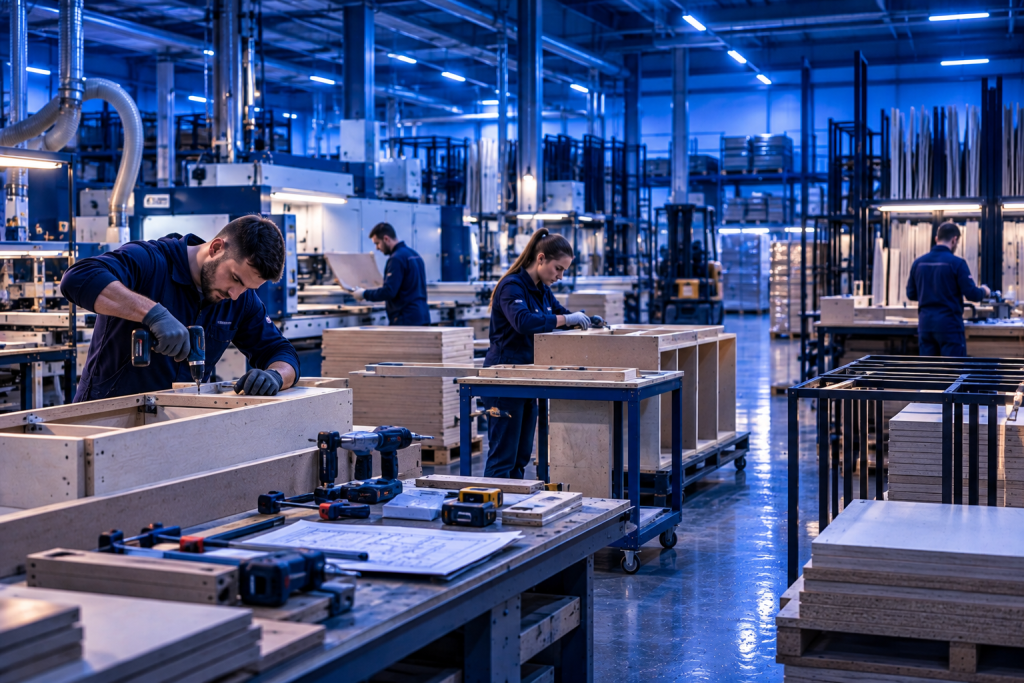
Furniture is one of Poland’s most important manufacturing industries and provides one of the strongest connections between the country and international retail. Polish factories possess capabilities in woodworking, laminating, CNC machining, finishing and repeatable production that can be applied to residential products as well as commercial counters, shelving and display furniture. Retail projects can require hundreds of identical fixtures delivered to multiple locations, making manufacturing consistency and production systems particularly important.
Commercial furniture can also incorporate metal, glass, lighting, electrical equipment and digital technology, creating opportunities for Poland’s wider industrial base. Metal fabricators experienced in laser cutting, bending, welding, machining and powder coating can produce frames, brackets and structural components even when retail has not historically been their main industry. Lighting manufacturers similarly influence the customer experience because colour temperature, brightness, beam angle and energy efficiency all affect how merchandise and commercial environments perform.
The consumer rarely sees this manufacturing network. A fashion store in London could contain timber furniture produced by one Polish factory, metal structures from another and lighting components from a third while presenting everything under the identity of one international brand. This invisible B2B layer is exactly what Global Retail Directory is designed to reveal. A Polish manufacturer does not need its name above a shop entrance to be an important part of global retail; it needs the capability, quality and visibility required for buyers to discover it.
Packaging, Food Manufacturing and Grocery Add Another Industrial Layer
Poland’s manufacturing importance extends beyond commercial interiors. Packaging businesses produce cardboard, plastics, labels, flexible packaging and other materials required by food, beauty, electronics, household goods, clothing and e-commerce. Packaging needs to protect products through manufacturing and transportation while communicating information and, in many consumer categories, contributing directly to presentation on the shelf. E-commerce creates different priorities because the outer package must survive courier networks rather than compete visually inside a supermarket.
Food manufacturing provides another substantial connection between Polish production and European retail. Domestic supermarkets sell extensive ranges of Polish products, while food manufactured within the country is exported throughout Europe and beyond. The process involves agricultural production, food processing, quality control, packaging, refrigeration, warehousing and distribution, meaning the supermarket shelf represents only the final visible stage of a much larger industrial system.
Grocery retail itself operates at significant scale through hypermarkets, supermarkets, discount retailers, convenience stores and independent businesses. Supplying national networks requires consistent products, accurate labelling, suitable packaging and disciplined delivery, while refrigerated and frozen categories depend on controlled temperatures throughout the supply chain. Packaging manufacturers, cold-storage operators and logistics companies therefore contribute directly to grocery retail even though consumers may never know their names, reinforcing GRD’s broad approach to the retail ecosystem.
Warehousing, E-Commerce and Logistics Strengthen Poland’s European Position
Poland’s geographic location has supported extensive development of warehousing and distribution infrastructure capable of serving domestic customers as well as cross-border European markets. Large consumer populations in Poland, Germany, Czechia and neighbouring countries make Central Europe strategically important for retailers deciding where inventory should be positioned. A well-located facility can potentially support several countries without requiring stock to be duplicated throughout the region.
E-commerce has made these facilities even more important. Modern distribution centres receive products, manage inventory, pick orders, process returns and coordinate movements between manufacturers, stores and individual customers, often using warehouse-management systems, scanning, conveyors and varying levels of automation. Parcel lockers have become a particularly visible part of Polish e-commerce infrastructure, demonstrating how innovation can happen within the physical delivery network rather than only through the website or mobile application used to place the order.
For GRD’s Transport & Logistics businesses, Poland therefore provides a substantial opportunity. International retailers and manufacturers can use Polish facilities as part of wider European distribution strategies, while domestic logistics businesses can support companies operating across several countries. The digital storefront may appear borderless, but the products behind it still need physical inventory, warehousing and delivery, making Poland’s central position commercially significant to both conventional and online retail.
Nearshoring Is Creating New Opportunities for Polish Manufacturers
Supply-chain disruption has encouraged European businesses to reconsider the risks of relying too heavily on very distant production locations. This does not mean Asian manufacturing or global sourcing will disappear, but companies increasingly value having alternative suppliers closer to their principal consumer markets. Poland can benefit particularly within furniture, metalwork, displays, packaging and specialist manufactured products where lead time, flexibility and the ability to correct problems quickly can influence the total project cost.
Nearshoring can also improve collaboration. European design teams can visit Polish factories relatively easily, prototypes can move between countries quickly and manufacturing changes can be implemented without waiting for extremely long transportation cycles. These advantages can be particularly important within retail rollouts where a product needs to be manufactured repeatedly but the design may continue evolving as stores are surveyed and project conditions become clearer.
For Polish manufacturers, the opportunity is therefore to compete through responsiveness, engineering and service rather than attempting to win every project through price alone. GRD can support this by helping international buyers identify Polish companies with relevant capabilities before an urgent sourcing problem occurs. Nearshoring becomes commercially useful only when retailers can actually discover suitable suppliers, understand what they manufacture and establish dependable relationships with them.
Retail Rollouts Require Manufacturing, Project Management and Installation to Work Together
Producing a technically correct fixture is not the same as successfully supplying a multi-site retail programme. A rollout can involve dozens or hundreds of stores with fixed opening dates, requiring every component to be manufactured correctly, identified clearly, packaged securely and delivered to the correct location according to the project sequence. Replacement components also need to remain available when damage or unexpected site conditions create problems.
A manufacturer supplying one bespoke counter can often solve difficulties informally, but a business supplying hundreds of locations needs systems. Production planning, documentation, quality control, project communication and logistics become as important as fabrication itself. Installation teams also need accurate information because a fixture that cannot pass through a doorway, freight lift or loading area can create significant delays regardless of how well it was manufactured.
Companies capable of combining these disciplines can become long-term partners to international retailers. A Polish manufacturer may begin by supplying stores in Poland or Germany and later follow the same customer into France, Scandinavia, the UK or other markets, while local Retail Installation Companies complete the final delivery in each destination. This creates precisely the type of international B2B network that Global Retail Directory is intended to connect.
Polish Brands and Manufacturers Can Expand Internationally
Poland is not only a production location for foreign companies. Domestic fashion, footwear, beauty, food and other consumer brands increasingly reach customers across Europe through physical stores and e-commerce. International expansion changes the organisation because a retailer operating only in Poland can depend heavily on domestic knowledge and suppliers, while opening locations abroad requires relationships within unfamiliar property, logistics and commercial environments.
The brand remains Polish, but the network supporting it becomes international. Fixtures might continue to be manufactured in Poland while local contractors install them in another country, and maintenance providers need to support stores after opening. Successful Polish Iconic Brands can therefore generate commercial opportunities for manufacturers and specialists in several markets as their store networks grow, demonstrating how one consumer brand can sit at the centre of a much larger B2B ecosystem.
Manufacturers can expand in a similar way by following their customers internationally. Once a retailer trusts a Polish supplier’s quality and service, the same manufacturer can potentially support projects throughout the retailer’s European network. International growth does not always require opening factories in every destination; it can develop through strong relationships, reliable export capability and cooperation with local installation and logistics partners.
Sustainability Is Becoming Part of Polish Manufacturing Competitiveness
European retailers increasingly ask suppliers for information about materials, energy consumption, waste and manufacturing processes, making environmental performance part of commercial procurement rather than simply corporate communication. Polish manufacturers that reduce waste, improve energy efficiency and use materials more effectively can lower their own operating costs while becoming more attractive to customers with sustainability targets.
Furniture and retail fixtures provide particularly strong opportunities for circular design. Metal frames can potentially remain in service while decorative surfaces change, components can be designed for replacement instead of requiring the entire fixture to be discarded and packaging can be reduced or reused during repeated rollout programmes. Designing commercial equipment for refurbishment can extend its useful life while reducing both waste and long-term retailer costs.
Sustainability becomes most effective when it is incorporated into engineering and manufacturing rather than added afterward as a marketing claim. Poland’s established industrial base gives companies an opportunity to develop practical solutions that improve environmental performance while maintaining commercial competitiveness. For international buyers, these capabilities can increasingly influence which manufacturers become long-term approved suppliers.
Connecting Polish Businesses Through Global Retail Directory
Poland contains thousands of businesses capable of contributing to international retail, but discovering the right company can still be difficult. A manufacturer may have excellent machinery, experienced staff and years of production knowledge while maintaining a relatively limited international digital presence. Its website might describe technical processes without explaining how those capabilities apply to retail, leaving an overseas buyer unaware that the company could satisfy exactly the requirement being searched for.
The Global Retail Directory is designed to reduce that discovery gap. Polish Manufacturers & Suppliers can present their production capabilities, Retail Installation Companies can demonstrate where they operate, Transport & Logistics businesses can connect with organisations requiring European distribution, and growing Polish Iconic Brands can become visible alongside businesses from other international markets. The categories are different, but they are connected by the same global retail ecosystem.
For overseas buyers, GRD provides a route toward discovering Polish capabilities without relying entirely on established contacts or generic searches. For Polish businesses, the platform creates international visibility to retailers, project organisations and potential commercial partners beyond their existing networks. Visibility does not replace quality or reliable service; it allows those qualities to be discovered by companies actively searching for them.
Poland’s Retail Strength Is Both Visible and Invisible
The visible side of the retail industry in Poland is easy to recognise. Warsaw and the country’s regional cities contain modern shopping centres, supermarkets, fashion stores, restaurants and increasingly integrated digital retail, while Polish consumer brands are becoming more confident internationally. These businesses represent the customer-facing side of a modern European retail economy.
The invisible side may be even more important to Poland’s international position. Factories manufacture furniture, metal businesses fabricate structures, lighting companies contribute to store environments, packaging businesses protect consumer products, food manufacturers supply supermarkets and warehouses distribute orders throughout Europe. These companies may never appear above a shop entrance, yet retail cannot function without the products and services they provide.
For Global Retail Directory, Poland therefore represents exactly the type of market the platform is designed to reveal. Its geographic position, industrial capability and access to European markets give Polish companies opportunities to support retailers far beyond the domestic economy, while international businesses need better ways to discover those capabilities. Poland is not simply a place where consumers shop; it is increasingly one of the places where European retail is manufactured, supplied, distributed and supported.