
Retail Industry in India
The retail industry in India is developing within one of the largest and most diverse consumer markets in the world. More than a billion consumers, rapidly expanding cities, established traditional commerce, domestic manufacturing, international investment and a highly developed digital economy combine to create a retail environment unlike almost any other market. Mumbai, Delhi NCR, Bengaluru, Hyderabad, Chennai, Pune, Kolkata and other major cities support increasingly sophisticated shopping environments, while hundreds of smaller cities and towns create another enormous layer of consumer demand.

What makes India particularly interesting is that modern retail is developing alongside, rather than simply replacing, long-established forms of commerce. Shopping centres, supermarkets, fashion chains and international brands operate within the same economy as neighbourhood kirana stores, family businesses, street markets and specialist independent retailers. Digital commerce adds another dimension by allowing brands to reach consumers far beyond the country’s largest physical shopping destinations, while digital payments have modernised transactions across businesses of almost every size.
For the Global Retail Directory, India is particularly important because it is simultaneously a consumer market, manufacturing centre, sourcing destination, technology economy and increasingly important source of international brands. Textile factories, jewellery manufacturers, technology businesses, packaging companies, logistics providers, designers and Retail Installation Companies can all participate in the wider retail ecosystem. The opportunity therefore extends far beyond opening stores and reaches into almost every part of the infrastructure supporting modern commerce.
Traditional Commerce and Modern Retail Are Developing Together
For millions of Indian consumers, everyday retail remains deeply local. Kirana stores, markets, family businesses and independent shops continue to play a central role in purchasing food, household products, clothing and other necessities. Their relatively small physical footprint can be offset by excellent locations within residential communities and strong relationships with customers, giving them a convenience advantage that larger retailers cannot always reproduce.
Technology does not necessarily remove this advantage. Digital payments, messaging platforms and delivery services allow smaller businesses to modernise while retaining their established physical presence and local character. A neighbourhood retailer can accept mobile payments, communicate with customers digitally and organise delivery without becoming a conventional chain store. India’s retail transformation therefore does not need to follow a simple progression in which traditional businesses disappear as modern formats expand.
For manufacturers and suppliers, understanding this coexistence is commercially important. A distribution strategy designed exclusively around large supermarkets and shopping centres can overlook enormous parts of the consumer market, while wholesalers and regional distributors can remain essential for reaching independent retailers. This demonstrates why GRD treats retail broadly: companies supporting traditional commerce through manufacturing, technology, supply and logistics can be just as relevant as businesses serving major organised retail networks.
Mumbai, Delhi NCR and Bengaluru Represent Different Urban Retail Economies
Mumbai occupies a central position within Indian commerce as a major financial, corporate, fashion and entertainment centre. Its retail environment ranges from luxury shopping and contemporary malls to dense commercial streets and traditional markets, while high property values and limited space can create demanding conditions for physical stores. International brands often use Mumbai to establish visibility within India, but successful store delivery requires an understanding of restricted access, traffic and complex urban buildings rather than simply reproducing a concept developed elsewhere.
Delhi and the wider National Capital Region provide another enormous consumer market, with commercial development extending through Delhi, Gurugram, Noida and surrounding areas. Modern shopping centres, office districts and residential developments have expanded alongside traditional retail, creating opportunities across fashion, beauty, technology, sports, food and lifestyle categories. The region demonstrates how urban development creates retail demand because new residential districts require grocery, healthcare, restaurants and services while corporate employment supports convenience, fitness and premium consumer businesses.
Bengaluru adds a third distinctive model through its technology economy and large professional workforce. Digital payments, online marketplaces, mobile applications and delivery platforms are deeply integrated into consumer behaviour, but physical stores remain important for service, demonstrations and immediate product access. Together, these cities show why India cannot be treated as one uniform retail market and why international brands need local partners capable of translating global concepts into very different metropolitan environments.
Shopping Centres Are Creating More Sophisticated Physical Retail
Modern shopping centres have become increasingly important across India’s major cities and rapidly developing regional markets. They provide international and domestic retailers with organised environments where brands, restaurants, entertainment and services operate together, while consumers gain access to climate-controlled destinations particularly valuable within densely populated cities and regions experiencing extreme seasonal temperatures.
For retailers, these developments introduce more formal project requirements. Designs need approval, contractors require coordination, deliveries need controlling and installation work may need to take place outside customer hours. Before a new centre opens, multiple retailers can be completing neighbouring units simultaneously, placing pressure on loading facilities, project schedules and contractor access. Successful store delivery therefore depends on planning well beyond the manufacture of individual fixtures.
This creates opportunities for furniture manufacturers, lighting businesses, technology providers and Retail Installation Companies throughout India. As organised retail expands beyond Mumbai, Delhi and Bengaluru, these capabilities need to become available across regional markets as well. GRD can help brands and project organisations discover companies capable of supporting physical retail across different parts of the country rather than relying entirely on suppliers concentrated within the largest cities.
Textiles, Apparel and Craftsmanship Give India Global Manufacturing Strength
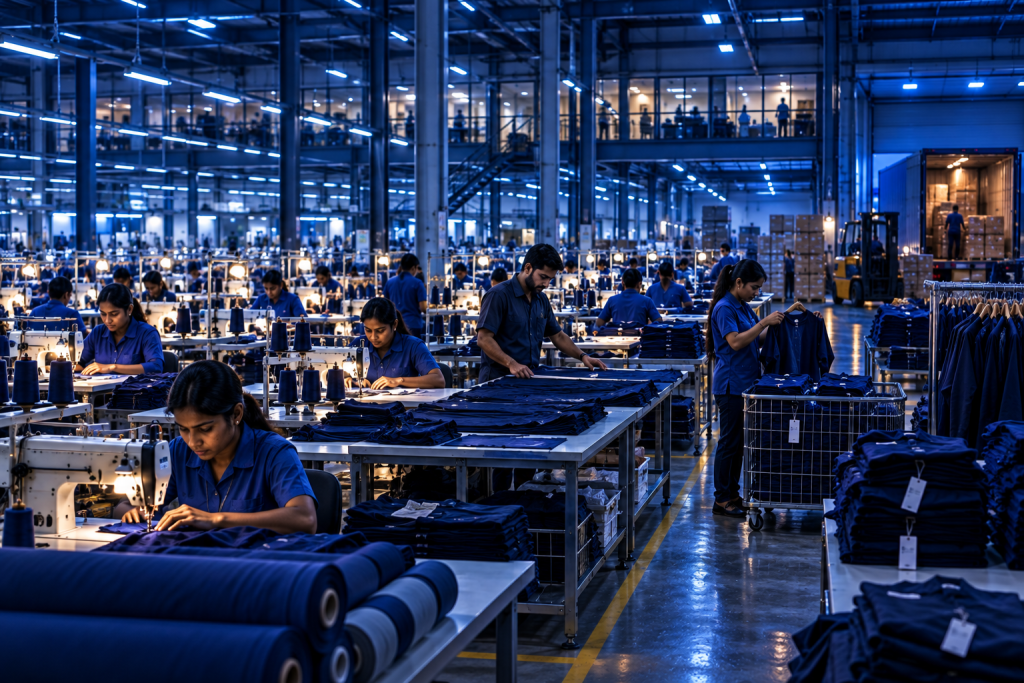
India is one of the world’s major textile and apparel producers, with capabilities extending across cotton, yarn, fabrics, garments, embroidery and specialist textile production. Large industrial factories can manufacture substantial volumes, while smaller producers and specialist workshops provide craftsmanship and flexibility. These capabilities serve domestic retailers while simultaneously connecting Indian businesses with fashion brands and buyers throughout international markets.
India’s manufacturing depth extends considerably beyond textiles. Jewellery production combines traditional craftsmanship with sophisticated international supply chains, while leather, footwear, ceramics, metalwork, wood products and decorative crafts create further opportunities. For retailers searching for differentiated products rather than completely standardised mass production, specialist Indian manufacturers can provide materials, techniques and design characteristics that are difficult to reproduce through generic sourcing.
The commercial challenge is combining this expertise with the consistency required by international B2B customers. Retailers need documentation, quality control, predictable delivery and reliable communication even when products depend on highly skilled manual work. For GRD’s Manufacturers & Suppliers category, India demonstrates why a company does not need to be a huge multinational organisation to become internationally relevant; a specialist producer with the right capability can be exactly what an overseas retailer, designer or project organisation is searching for.
Advanced Manufacturing Is Expanding India’s Role in Retail
India is becoming increasingly important within international manufacturing strategies across electronics, automotive, engineering, consumer products and technology hardware. This development has implications for retail far beyond the products eventually appearing on shelves because industrial growth creates supplier networks, technical skills, packaging businesses, warehousing and transport infrastructure that can support numerous commercial sectors.
Electronics are particularly relevant because stores themselves contain increasing amounts of technology. Digital displays, payment systems, kiosks, electronic security, connected inventory equipment and interactive installations all require hardware, while furniture increasingly needs to accommodate screens, power, connectivity and ventilation. A manufacturer originally serving technology or industrial customers can therefore develop capabilities relevant to modern commercial environments without having historically identified as a retail supplier.
This overlap is central to Global Retail Directory’s broad interpretation of the industry. An engineering business, electronics manufacturer or metal fabricator may contribute directly to retail projects even if stores represent only one part of its customer base. As Indian manufacturing becomes more technically sophisticated, the opportunity increases for domestic companies to supply not only consumer products but also the equipment and infrastructure through which those products are sold.
India’s Continental Scale Makes Logistics a Strategic Retail Capability
India’s geography creates one of the most significant operational challenges within its retail industry. A national retailer can operate stores across Delhi, Mumbai, Bengaluru, Chennai, Hyderabad and Kolkata while simultaneously expanding into dozens of smaller cities separated by substantial distances. Serving such a network requires far more than one central warehouse and a fleet of vehicles because inventory, project equipment and maintenance resources need to be positioned according to regional demand.
Store-development programmes introduce their own requirements. Fixtures manufactured in one region may need consolidation before being distributed toward individual locations, while accurate packing and identification become critical when installation teams are working far from the manufacturing base. Discovering that one essential component is missing after equipment and labour have travelled hundreds of kilometres can create delays far more expensive than the value of the missing item itself.
This gives GRD’s Transport & Logistics businesses a genuine role within the Indian retail ecosystem. Warehousing, fulfilment, regional distribution and project logistics connect manufacturers with stores and consumers, while retailers operating nationally need partners capable of maintaining consistent service across several regions. India’s scale rewards companies that can combine physical infrastructure with accurate information and disciplined project management.
E-Commerce and Digital Payments Have Expanded the Reach of Indian Retail
Digital commerce has allowed brands to reach consumers far beyond the country’s largest metropolitan shopping destinations. A conventional retailer expanding nationally needs property, staff and inventory within each market, while an online business can begin building demand much earlier. This has created opportunities for Indian fashion, beauty, homeware and specialist consumer businesses to develop national audiences before committing to extensive physical store networks.
Successful digital businesses can later move in the opposite direction by opening stores after customer data shows where physical demand is concentrated. The store can then function as a showroom, service location, collection point or marketing environment as well as a place where transactions occur. E-commerce and physical retail therefore increasingly operate as complementary parts of one commercial strategy rather than competing models.
Digital payments have accelerated this transformation across businesses of almost every size. A neighbourhood shop can adopt mobile payment and delivery tools without changing its premises, while large retailers can integrate payment systems with loyalty, inventory and online ordering. Technology modernises both traditional and organised retail, creating opportunities for Indian companies whose contribution to the industry exists primarily through software, payments or digital infrastructure rather than physical products.
Indian Brands Can Build Scale at Home Before Expanding Internationally
India’s enormous domestic market gives successful brands an opportunity to reach substantial scale before entering other countries. Fashion, jewellery, beauty, food, hospitality, technology and lifestyle companies can build recognition among Indian consumers and diaspora communities before committing resources to wider international expansion. This domestic foundation can provide product knowledge, manufacturing volume and operational experience that smaller home markets may not offer.
International expansion changes the type of support these companies require. A retailer opening its first overseas store needs to understand unfamiliar property, regulations, construction and supply networks, while furniture manufactured in India may require international freight and destination installation. Technology systems need local compatibility, maintenance resources need to be available and consumer behaviour may require the original Indian store concept to be adapted without losing the brand’s identity.
Within Global Retail Directory, these growing Iconic Brands connect naturally with the B2B companies surrounding them. A successful Indian brand expanding internationally can create opportunities for domestic manufacturers that follow its growth while simultaneously requiring installation, logistics and maintenance partners within destination countries. One consumer-facing business can therefore create commercial relationships across several parts of the global retail ecosystem.
International Brands Need to Understand India Rather Than Simply Enter It
India’s consumer scale makes it attractive to international retailers, but the size of the opportunity can obscure the complexity of the market. Income levels, climate, languages, consumer preferences and commercial conditions vary considerably between regions, meaning a product or store format successful in one metropolitan area may require different positioning elsewhere. India should therefore be approached as a collection of connected markets rather than one uniform consumer environment.
Pricing and product strategy are particularly important. Premium global concepts can work within affluent urban markets, while businesses attempting to reach much broader customer groups may need different product ranges, formats and price structures. Local sourcing can become part of the solution because manufacturing products or store fixtures domestically can reduce some international supply-chain complexity while giving brands access to suppliers familiar with Indian conditions.
Partnerships consequently become important for market entry. International companies can benefit from Indian manufacturers, designers, developers, technology providers and installation specialists rather than attempting to reproduce an overseas supply chain unchanged. GRD can support this process by giving international organisations a structured way to discover relevant Indian businesses according to capability rather than beginning every market entry entirely through existing personal contacts.
India’s Climate and Urban Conditions Influence Store Development
Physical retail in India needs to operate across widely different climatic environments. Northern regions can experience substantial seasonal temperature variation, while southern and coastal markets face heat and humidity and monsoon conditions can affect transportation, buildings and construction schedules. Retail materials and equipment therefore need to be selected according to destination rather than assuming a specification developed for another country will perform identically throughout India.
Dense cities introduce another practical challenge. Deliveries can need to navigate congested roads, restricted loading areas and complex buildings, while large prefabricated fixtures may be difficult to move through existing properties. Good retail development therefore begins with understanding site access, transport and assembly before manufacturing is complete. A visually impressive fixture that cannot reach its final position is not a successful product.
These conditions create opportunities for local Retail Installation Companies and manufacturers whose experience allows them to anticipate practical problems before they reach the site. International brands can maintain consistent visual identities while adapting the project-delivery process to individual locations, demonstrating that global brand standards and local execution are not contradictory but complementary.
Sustainability and Longevity Matter at Indian Scale
India’s scale means relatively small improvements in resource efficiency can produce substantial cumulative effects. Retail fixtures, packaging, warehouses and commercial buildings all consume materials and energy, while large store networks multiply those requirements across hundreds or thousands of locations. Designing equipment for longer life or easier repair can therefore reduce repeated manufacturing and replacement while also lowering long-term operating costs.
Energy use inside stores is particularly important because cooling, lighting and refrigeration can represent significant expenditure in many parts of the country. Efficient systems can provide environmental benefits while making straightforward commercial sense, and manufacturers can contribute by developing modular products that can be updated or repaired rather than discarded during every refurbishment.
Local sourcing can sometimes reduce transportation requirements, although sustainability needs to be evaluated across the entire product lifecycle rather than through distance alone. The strongest approach combines material efficiency, durability, energy performance and practical maintenance. For Indian manufacturers, developing these capabilities can also improve competitiveness as international retailers place greater emphasis on environmental performance throughout their supply chains.
Connecting Indian Businesses Through Global Retail Directory
The scale of India creates an unusual B2B discovery problem. There are enormous numbers of manufacturers, suppliers, technology businesses and commercial specialists capable of contributing to retail, but identifying the right company can be difficult for organisations located elsewhere. A European retailer may need an Indian textile manufacturer with particular production capabilities, while a global brand entering Bengaluru may need businesses capable of supporting its physical store programme.
Indian companies face the reverse problem. A manufacturer can produce excellent products while remaining visible primarily to existing customers or intermediaries, limiting access to buyers in other countries. Professional international visibility becomes particularly important when the capability itself is already strong but potential customers do not know the company exists.
The Global Retail Directory is designed around this discovery challenge. Indian Manufacturers & Suppliers, Retail Installation Companies, Transport & Logistics businesses and growing Iconic Brands can become visible within the same international platform while retaining their different roles within the industry. The purpose is not to define retail narrowly, but to connect the businesses whose combined capabilities allow modern retail to function.
The Next Stage of the Retail Industry in India
The future of the retail industry in India will not be a simple transition from traditional shops to shopping centres or from physical stores to e-commerce. These formats are likely to continue developing simultaneously, with neighbourhood retailers becoming more digital, shopping centres expanding into regional markets, e-commerce businesses opening physical locations and traditional manufacturers developing increasingly sophisticated relationships with domestic and international brands.
Technology will connect more of these activities, but physical infrastructure will remain essential. Products still need manufacturing, inventory needs warehousing, stores need building and maintaining and customers continue to value environments where they can see, touch and experience products. India’s extraordinary scale means even relatively small changes in consumer behaviour can create enormous opportunities for manufacturers, suppliers and service businesses supporting the industry.
For Global Retail Directory, India represents far more than a large consumer market. It is a manufacturing base, technology economy, sourcing destination, brand incubator and rapidly evolving physical retail environment at the same time. Connecting those capabilities internationally can help overseas businesses discover Indian expertise while giving Indian companies greater visibility to retailers and project organisations around the world — making India one of the most important markets within the evolving global retail ecosystem.