
Retail Industry in South Korea
The retail industry in South Korea operates within one of the world’s most technologically connected consumer markets, where physical stores, mobile commerce, entertainment, beauty, fashion and digital experiences increasingly overlap. Seoul provides the country with a retail capital of international significance, while Busan, Incheon, Daegu and other cities contribute substantial regional markets and connect South Korean businesses with international manufacturing, logistics and trade.

South Korea’s influence extends considerably beyond the size of its domestic population. Korean beauty products are sold internationally, electronics and automotive brands have become household names, Korean food occupies growing areas of supermarkets around the world and fashion and lifestyle businesses increasingly benefit from the international popularity of Korean culture. Music, television, social media and entertainment can introduce consumers to Korean products long before those customers have visited the country or encountered a dedicated Korean store.
For the Global Retail Directory, South Korea provides a particularly strong example of how modern retail connects manufacturing, technology, branding and international consumer culture. Behind the visible brands sit cosmetics manufacturers, packaging companies, electronics businesses, designers, display producers, logistics providers and Retail Installation Companies. These businesses may perform completely different functions, but together they create the commercial ecosystem through which Korean products and retail concepts reach customers around the world.
Seoul Is a Retail City That Rarely Stands Still
Seoul contains an extraordinary variety of retail environments, from luxury department stores and premium shopping districts to underground retail, neighbourhood businesses, convenience stores, specialist beauty retailers and highly designed flagship environments. Different areas have developed distinctive commercial identities: Myeongdong is internationally associated with beauty, shopping and tourism, Gangnam combines premium commerce with corporate activity and entertainment, while Hongdae attracts younger consumers through fashion, music, nightlife and independent businesses.
This gives retailers the opportunity to choose locations according to the identity they want to communicate rather than simply according to available floor space. A luxury brand does not necessarily want the same environment as an emerging streetwear company, while a beauty business introducing experimental products can benefit from a district where customers actively search for new concepts. Retail property therefore becomes part of brand positioning, and individual neighbourhoods can function almost like different consumer markets within the same metropolitan area.
For businesses delivering stores, this constant change creates recurring opportunities. New concepts require furniture, lighting, technology and installation, while existing locations are frequently updated as brands respond to rapidly changing customer expectations. GRD can help international brands identify South Korean Manufacturers & Suppliersand retail specialists while allowing Korean businesses with experience in Seoul’s demanding commercial environment to present those capabilities internationally.
Korean Consumers Expect Physical and Digital Retail to Work Together
Technology in South Korean retail is not simply decorative. Consumers operate within an environment where smartphones, high-speed connectivity, digital payments and online services are deeply integrated into everyday life, allowing customers to compare products, research reviews and move between physical and digital purchasing without treating them as completely separate channels.
This places high expectations on retailers. A visually impressive store cannot compensate for inaccurate inventory information, unnecessary payment friction or a poor digital experience. Technology can also improve the physical environment through digital displays, mobile stock information, electronic systems and customer-service tools, but the strongest implementations often become almost invisible because they simply make the shopping process easier.
The integration of technology also changes what manufacturers need to produce. Furniture can require power, data connectivity, ventilation and maintenance access, while displays increasingly combine conventional materials with screens and electronic components. This creates opportunities for businesses capable of working across traditional boundaries between manufacturing, technology and physical store delivery, which is why GRD’s broad retail ecosystem is particularly relevant to South Korea.
Convenience Stores Reveal Another Side of Korean Retail Innovation
Some of South Korea’s most interesting retail development occurs within convenience stores rather than enormous flagship locations. These businesses are deeply integrated into urban life and provide food, drinks and everyday necessities while increasingly supporting prepared meals, parcel services, payments and other practical functions. Their value comes from proximity, speed and the ability to respond closely to the needs of customers living or working nearby.
High store density creates intense competition, meaning retailers need detailed understanding of local demand. Product ranges can change rapidly, and new food or beverage trends can spread through networks at remarkable speed. A relatively small store therefore depends on sophisticated information, distribution and replenishment systems behind the scenes, while limited back-of-house space makes reliable deliveries particularly important.
Convenience retail also demonstrates the commercial importance of packaging. Products compete for attention within compact environments and need to communicate quickly while remaining suitable for refrigeration, shelving and transportation. A successful product can potentially reach thousands of locations, creating substantial opportunities for food manufacturers, packaging companies and logistics providers capable of supplying consistent volumes across large networks.
K-Beauty Connects Product Development with Global Retail
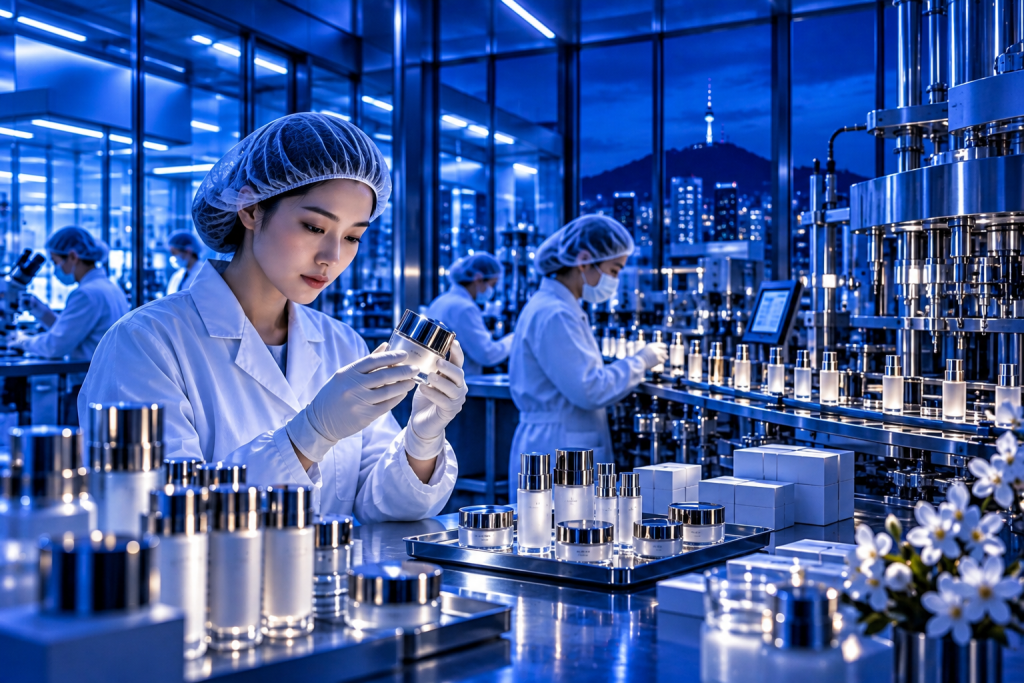
Few industries demonstrate South Korea’s international retail influence more clearly than beauty. Korean skincare and cosmetics have developed substantial global recognition, with products sold through specialist stores, department stores, pharmacies, e-commerce platforms and major international retailers. The success of K-beauty is not based on one company or product but on a wider ecosystem involving formulation specialists, laboratories, contract manufacturers, packaging businesses, designers and consumer brands.
This structure creates significant B2B opportunities. A beauty company can concentrate on product concept, customer identity and marketing while specialist manufacturers provide technical formulation and production capabilities. Packaging becomes equally important because bottles, containers, cartons and applicators need to function correctly while communicating quality immediately to customers. The finished consumer product is therefore the result of several specialised businesses working together.
For GRD’s Manufacturers & Suppliers category, South Korea offers opportunities extending well beyond purchasing finished cosmetics. International businesses may be searching for contract manufacturing, packaging, formulation expertise or specialist components, while Korean suppliers can use greater international visibility to develop relationships with brands in completely different markets. The global success of K-beauty demonstrates how sophisticated B2B capability can sit behind highly visible consumer brands.
Beauty, Fashion and K-Culture Are Turning Stores into Discovery Environments
Beauty retail demonstrates how the purpose of the physical store is changing. Customers frequently arrive after encountering products through social media, influencers or online reviews, meaning the store becomes a place to test textures, colours, fragrances and packaging physically. Lighting needs to represent colours accurately, displays need to encourage interaction and testers require organisation and hygiene, making the environment closer to an interactive showroom than a conventional shelf-based store.
Korean fashion benefits from the same global cultural ecosystem. International consumers encounter styles through entertainment and social media before discovering the individual brands behind them, while visitors to Seoul can use physical retail as part of cultural discovery. A consumer can encounter a Korean brand during a trip, return home and continue purchasing digitally, allowing tourism and e-commerce to reinforce one another.
K-pop extends this relationship into merchandise, collectables, beauty collaborations and temporary retail experiences. Pop-up stores can generate enormous attention despite existing only briefly, creating projects where furniture, graphics, technology, products and installation all need to be coordinated within compressed schedules. For Retail Installation Companies and manufacturers, temporary retail can therefore be just as technically demanding as permanent stores, only with considerably less time available for delivery.
Department Stores and Seongsu Show Two Different Directions for Physical Retail
South Korea’s sophisticated department-store sector remains important to premium physical commerce, combining luxury fashion, beauty, food, lifestyle and services within highly controlled environments. International brands can access established customer bases through these properties, but individual concessions still require custom furniture, lighting and visual presentation while complying with both the brand’s global standards and the department store’s technical requirements.
These concession environments create continuing B2B activity because seasonal campaigns, product launches and refurbishment can require frequent changes. The customer may see only a beautifully finished beauty counter or fashion concession, while behind it sits a network involving designers, manufacturers, freight providers, installers and visual-merchandising teams. Even relatively small spaces can therefore generate sophisticated international supply chains.
Seongsu demonstrates a very different direction in physical retail. Former industrial buildings and workshops have attracted cafés, fashion businesses, beauty brands, pop-ups and creative companies, with the architecture itself becoming part of the appeal. Instead of hiding industrial character, brands can use it to create environments that feel distinctive and less standardised, showing how retail development can contribute to urban regeneration while preserving elements of a district’s previous identity.
Electronics and Advanced Manufacturing Support the Modern Store
South Korea is home to globally significant electronics and technology industries, and their relationship with retail operates in two directions. Electronics companies sell products through retail networks around the world, while screens, connected devices and digital infrastructure manufactured by technology businesses increasingly become components of stores themselves.
Technology retail is particularly experience-driven because customers want to handle devices, compare displays and understand how products work together. Furniture consequently becomes technical: a table can require cable management, ventilation, power supplies, connectivity and security while still appearing visually simple. Designers, furniture manufacturers and electronics specialists therefore need to coordinate much earlier than they would for conventional display furniture.
South Korea’s manufacturing strength also extends beyond electronics into plastics, textiles, food products, packaging, automotive components and specialist commercial equipment. For international buyers, the opportunity is therefore broader than sourcing well-known Korean technology. GRD can help reveal specialist Manufacturers & Supplierswhose technical capabilities may be relevant to retail projects even when they have traditionally served other industries.
Packaging and Food Are Important Parts of Korea’s International Retail Growth
The global success of Korean beauty and food products demonstrates the importance of packaging particularly clearly. Packaging protects products during transportation, communicates instructions and regulatory information and needs to work efficiently during manufacturing and distribution. On the shelf or within an e-commerce image, it also becomes part of the marketing, especially in visually competitive categories where the customer’s first interaction may be with the package rather than the product itself.
Sustainability adds another requirement because companies increasingly need to reduce unnecessary material without compromising protection or premium presentation. Businesses capable of balancing technical performance, visual design and environmental efficiency can therefore become particularly valuable to consumer brands. For international companies sourcing in South Korea, packaging specialists may be as commercially important as the manufacturer producing what sits inside the container.
Korean food provides another example of consumer products moving from cultural awareness into international retail. Products once concentrated within specialist Asian supermarkets increasingly appear within mainstream grocery stores in Europe, North America and other markets, supported by interest generated through restaurants, entertainment and social media. As demand grows, opportunities expand for Korean food manufacturers, packaging businesses, exporters and international distributors.
E-Commerce Has Changed Expectations Around Speed and Fulfilment
South Korea’s dense urban population and advanced digital infrastructure have helped create sophisticated e-commerce and fulfilment systems where consumers increasingly expect fast and predictable delivery. The digital transaction may appear almost instantaneous, but meeting that expectation requires extensive physical infrastructure involving warehouses, inventory systems, picking, packaging and highly organised distribution networks.
This illustrates one of the central characteristics of modern digital retail: the easier purchasing becomes for customers, the more sophisticated the infrastructure behind it needs to be. Accurate inventory is essential, orders need to move efficiently through fulfilment facilities and distribution needs to connect dense urban populations with products quickly. Warehousing and Transport & Logistics therefore become more important as digital commerce develops rather than less.
Physical stores can also become part of this network through collection, returns and local inventory, further reducing the distinction between store and fulfilment infrastructure. For companies supplying automation, warehouse equipment, packaging and technology, South Korea’s e-commerce environment creates B2B opportunities that remain largely invisible to the consumer using the final digital service.
Dense Korean Cities Reward Efficient Store Design and Installation
South Korea is highly urbanised, and Seoul in particular operates at densities very different from many lower-density international markets. Stores can occupy multiple floors, basements and mixed-use developments where customers move vertically rather than through large single-level environments. Retail space therefore needs to be used efficiently while navigation and product visibility remain clear.
Dense properties also create practical delivery challenges. Large equipment cannot simply arrive whenever convenient, while lifts, entrances and loading facilities can determine how fixtures need to be manufactured and packaged. A visually standardised concept may therefore require modular furniture or different installation sequences according to the building in which it is being delivered.
This gives local Retail Installation Companies and manufacturers an important role because they understand how commercial concepts interact with Korean properties. International brands can preserve their visual identity while adapting physical delivery to local conditions, demonstrating that standardised branding does not require every project to be executed through exactly the same process.
Busan Connects Korean Retail with International Trade
Seoul dominates discussion of South Korean retail, but Busan provides another important commercial perspective. The city combines a major population centre with one of the world’s significant container ports, creating direct connections between domestic commerce, manufacturing and international supply chains. Tourism, food and the coastal economy add further consumer activity distinct from the capital.
The port allows Korean manufacturers to move products toward markets around the world while imported products, raw materials and components enter domestic supply chains in the opposite direction. A product displayed inside a Korean store can therefore have crossed several borders before reaching the customer, while Korean cosmetics, electronics, food or other goods travel outward through the same wider trade infrastructure.
For GRD’s Transport & Logistics and manufacturing categories, Busan demonstrates the physical relationship between production and international consumption. A manufacturer’s ability to reach global customers depends not only on what it produces but on packaging, documentation, warehousing and transportation capable of moving that product reliably beyond Korea.
Automotive Brands Create Another International Korean Retail Network
South Korea’s automotive industry creates an extensive retail ecosystem of its own. Vehicle showrooms are increasingly sophisticated customer environments incorporating digital configurators, large screens, carefully controlled lighting, customer lounges and technology demonstrations rather than simply functioning as buildings in which vehicles are displayed.
Electric vehicles add new requirements around charging infrastructure, product education and digital systems, meaning showroom design evolves alongside the product itself. Furniture, technology and electrical systems need to operate together, while maintenance and future upgrades become important as technology changes more quickly than the physical building.
International expansion gives this sector another dimension because Korean automotive brands require recognisable customer environments across many countries. Architects, furniture manufacturers, technology providers and installation businesses can therefore participate in dealership programmes far beyond South Korea. Once again, the consumer sees one global brand while a large B2B network operates behind it.
Pop-Ups Allow Korean Brands to Test International Markets
Temporary retail has become particularly useful for Korean beauty, fashion and entertainment brands entering new countries. A permanent flagship represents a substantial financial commitment, while a pop-up allows a business to test customer demand, understand local behaviour and generate marketing attention before deciding whether long-term physical expansion is justified.
Successful temporary stores can create queues and substantial social-media visibility, effectively combining retail with an event. Their short lifespan does not make delivery simple because everything still needs to be designed, manufactured, transported and installed, often according to highly compressed programmes. Opening dates connected with launches or cultural events can leave little flexibility when something goes wrong.
These projects create international opportunities for businesses within the GRD ecosystem. A Korean brand entering London, Paris or New York can retain design and manufacturing relationships in Korea while using local logistics and installation partners within the destination market. Temporary retail therefore provides another example of how one consumer-facing concept can connect businesses operating on opposite sides of the world.
Sustainability Is Challenging Korea’s Fast-Moving Retail Culture
South Korea’s rapidly changing retail concepts create an obvious sustainability challenge because pop-ups, seasonal displays and frequent refurbishments can consume significant quantities of materials. Temporary environments do not necessarily need to be disposable, however, and modular structures, replaceable graphics and furniture designed for repeated use can reduce the amount of equipment discarded after each campaign.
Warehousing can support this approach by storing reusable components between projects, while manufacturers can select materials that can be repaired, refinished or recycled more easily. For brands operating frequent campaigns, reuse can also provide financial benefits because the same structural equipment can support several different visual concepts rather than being manufactured again each time.
This creates an opportunity for Korean designers and manufacturers to combine rapid retail innovation with longer asset life. Sustainability becomes most effective when it is incorporated into engineering and project planning rather than added afterward, allowing brands to maintain the fast-moving character of Korean retail while reducing unnecessary waste.
Connecting South Korean Businesses Through Global Retail Directory
South Korea contains a large number of businesses whose capabilities are relevant internationally but may not always be easy for overseas buyers to discover. A retailer could need a Korean cosmetics manufacturer, an international brand might require specialist packaging or technology, while a Korean company expanding overseas can need installation, logistics or maintenance partners within destination markets.
The Global Retail Directory is designed to make these relationships easier to establish. South Korean Manufacturers & Suppliers can present specialist production capabilities, Retail Installation Companies can demonstrate where they operate, Transport & Logistics businesses can connect manufacturing with international markets and Iconic Brands can represent the consumer-facing companies whose growth creates opportunities throughout the wider industry.
South Korea demonstrates particularly clearly why these categories increasingly overlap. A beauty company can simultaneously depend on contract manufacturing, sophisticated packaging, e-commerce, physical stores and international logistics, while a technology manufacturer can supply both consumer products and the infrastructure used by retailers. GRD provides a way to make those connections visible across industries and borders.
South Korea Offers a Glimpse of Where Retail Is Going
The future of the retail industry in South Korea will continue to be shaped by technology, highly connected consumers, global cultural influence and the increasingly blurred boundary between physical and digital commerce. Stores can become places where customers experience products already discovered online, while convenience stores evolve into neighbourhood service hubs and pop-ups transform shopping into short-lived cultural events capable of reaching global audiences through social media.
South Korea’s international influence adds another dimension because the country is not simply adopting global retail trends. Beauty products developed in Korea become international categories, food reaches mainstream supermarkets abroad, fashion benefits from cultural visibility and electronics and automotive companies maintain enormous global retail networks. Manufacturing, technology and consumer culture reinforce one another.
For Global Retail Directory, that combination makes South Korea particularly relevant. International businesses need access to Korean manufacturers and specialist suppliers, while Korean brands expanding overseas need logistics, installation and commercial partners in destination markets. South Korea demonstrates how the next generation of retail can become physical and digital, cultural and commercial, domestic and international — all operating together within one connected global ecosystem.