
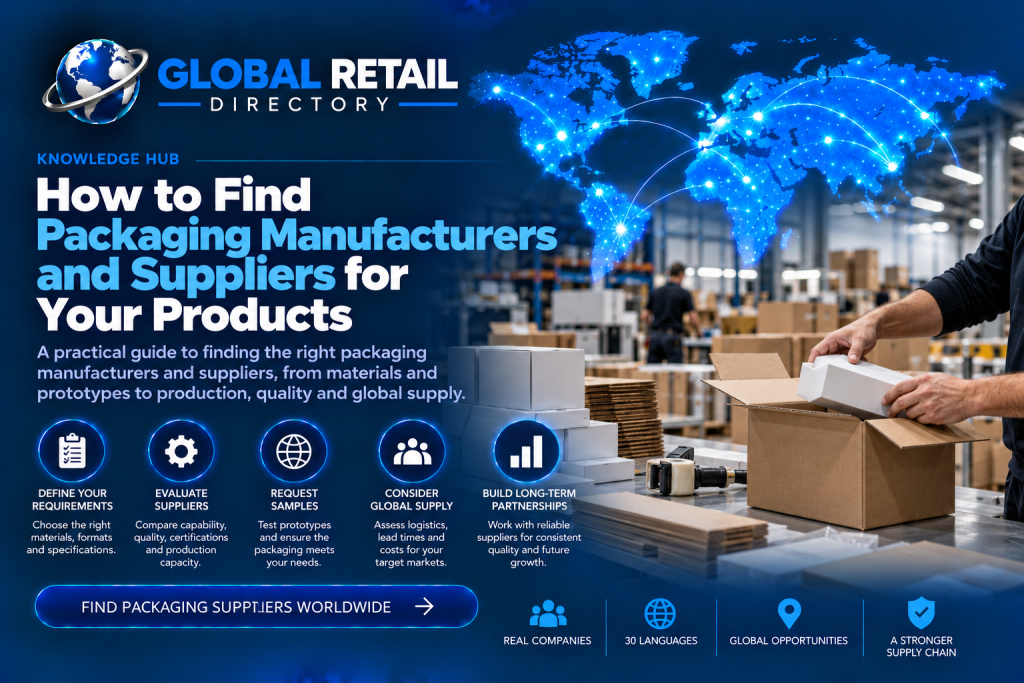
How to Find Packaging Manufacturers and Suppliers for Your Products
Finding the right packaging manufacturer or supplier is an important part of bringing almost any physical product to market. Food, beauty, electronics, fashion, homeware and countless other consumer categories depend on packaging to protect products, communicate information and create the presentation customers eventually see in stores or when an e-commerce order arrives at their home.

Packaging also sits directly between manufacturing and logistics. A package that looks excellent on a shelf can still fail commercially if it does not protect the product during transportation, uses excessive space inside cartons or creates unnecessary cost throughout warehousing and distribution. International sourcing introduces additional considerations around materials, printing, minimum order quantities, product compliance, quality control and freight.
Successful packaging sourcing therefore requires more than finding a factory capable of printing a box or producing a container. Businesses need to understand the product, retail channel, expected volumes, manufacturing process and complete supply chain before selecting a supplier. The objective is to create packaging that works technically, commercially and visually while remaining practical to manufacture repeatedly at the required scale.
Define Exactly What the Packaging Needs to Do
Packaging development should begin with the product rather than the appearance of the box, bottle or container. Buyers need to understand dimensions, weight, fragility, storage conditions and expected shelf life before deciding which packaging materials and structures are appropriate. Food, liquids, cosmetics and electronic products can all have very different technical requirements even when the finished packages appear similar in size.
The sales channel matters equally. Packaging designed primarily for a supermarket shelf needs strong customer-facing presentation and efficient shelf utilisation, while e-commerce packaging needs to survive courier networks and potentially much more individual handling. Products sold through both channels may require a primary consumer package combined with separate protective shipping packaging.
The specification should also consider how customers actually use the product. Opening, resealing, dispensing, storage and disposal can all influence the experience after purchase. Good packaging therefore protects the product while supporting manufacturing, distribution, merchandising and customer use rather than solving only one part of the journey.
Choose the Right Packaging Format for the Product
Packaging manufacturers specialise in different formats, materials and production technologies. Folding cartons, corrugated boxes, rigid boxes, flexible pouches, bottles, jars, tubes, trays and protective inserts all require different equipment and technical knowledge. A supplier excellent at premium printed cartons may have little relevance to a company needing food-grade flexible packaging.
Buyers should therefore identify the basic format before beginning broad supplier research. Material choice can then be developed according to product protection, appearance, cost and environmental requirements. Paperboard, corrugated fibreboard, glass, metal and different plastics each provide advantages and limitations according to the application.
Some products require several packaging layers working together. A cosmetic product can have a bottle or jar inside a printed carton, which is packed into a shipping case before being palletised for distribution. Evaluating these layers as one system can reveal opportunities to reduce material, improve protection and lower transportation cost.
Understand the Difference Between Packaging Manufacturers and Distributors
A packaging manufacturer physically produces the packaging using printing, converting, moulding, forming or other manufacturing processes. A distributor or packaging supplier may instead source standard or customised products from several factories and provide them to customers through one commercial relationship.
Working directly with a manufacturer can provide advantages for large volumes and highly customised products because the buyer communicates more closely with the production facility. Tooling, material specifications and technical changes can potentially be controlled more directly, particularly when the product requires specialist manufacturing.
Distributors can provide different advantages when businesses require several packaging types or relatively modest quantities. One supplier may provide cartons, tape, protective materials and shipping boxes without the buyer establishing separate relationships with every underlying manufacturer. The correct model therefore depends on volume, technical complexity and the amount of supply-chain management the buyer wants to handle internally.
Prepare Accurate Packaging Specifications
Manufacturers need detailed specifications before meaningful quotations can be produced. Dimensions, materials, thicknesses, colours, printing methods, finishes, closures and quantities should all be defined as clearly as possible, while technical drawings or dielines can communicate the structure of cartons and other converted packaging.
Artwork should be managed separately from structural specification. Branding, regulatory information, barcodes and instructions need to fit accurately within the available print area, but the underlying package still needs to function mechanically. Structural prototypes can therefore be valuable before expensive final artwork and printing decisions are approved.
Specifications also provide the basis for supplier comparison. If several factories quote against different assumptions about material weight, printing quality or finishing, their prices cannot be compared fairly. A common technical specification allows buyers to understand whether commercial differences reflect genuine manufacturing efficiency or simply different interpretations of the requirement.
Research Packaging Manufacturing Regions and Supplier Markets
Packaging manufacturing exists in almost every major economy because products usually require packaging relatively close to where they are produced or consumed. However, different regions can develop particular strengths in paper products, glass, plastics, flexible packaging, premium boxes or specialist printing.
Domestic and regional suppliers can offer advantages through shorter lead times and lower transportation requirements, particularly for bulky products such as corrugated boxes. International sourcing may become more attractive for premium packaging, specialist manufacturing or large volumes where production economics justify longer transportation.
Buyers should therefore avoid assuming that the lowest factory price automatically identifies the best sourcing region. Packaging can contain a large amount of empty volume, making freight disproportionately expensive compared with the product value. The complete landed cost and supply-chain flexibility should be considered before choosing between domestic, regional and overseas manufacturing.
Verify Packaging Manufacturers Before Placing Large Orders
A supplier should be evaluated according to the packaging being sourced rather than simply its overall factory size. Machinery, material handling, printing capability, quality systems and experience with comparable products can all influence whether the manufacturer is appropriate for the project.
Buyers can request examples of similar work and information about production equipment, capacity and quality-control procedures. Video calls can provide useful preliminary visibility, while factory visits or independent audits can be appropriate for significant programmes or packaging involving sensitive product requirements.
Capacity deserves particular attention when volumes are expected to grow. A supplier may comfortably produce an initial order but struggle during seasonal peaks or major product launches. Understanding normal capacity, existing workload and contingency arrangements can reduce the risk that successful sales eventually create packaging shortages.
Request Samples and Prototypes Before Production
Packaging should be tested physically before large production quantities are approved. Digital artwork can show appearance, but it cannot demonstrate how a carton feels, whether a closure works correctly or how effectively the structure protects the product.
Structural samples can initially be produced without final printing, allowing dimensions and functionality to be evaluated economically. Once the structure is approved, printed prototypes or production samples can be used to assess colour, finish, typography and overall presentation.
Testing the actual product inside the package is particularly important. Inserts can fit differently from expectations, containers may move during transportation and customers can find apparently simple opening mechanisms frustrating. Identifying these issues before mass production protects both the product and the investment already made in branding and packaging development.
Test Packaging Under Real Distribution Conditions
Packaging should be designed for the journey the product will actually experience rather than only how it looks when placed carefully on a desk. Products can pass through factories, warehouses, pallets, vehicles, fulfilment centres and courier networks before reaching the final customer.
Appropriate testing can evaluate compression, vibration, impact, moisture and other conditions depending on the product and distribution model. A premium carton may need an additional protective outer case, while e-commerce products can require significantly more robust packaging because individual parcels experience different handling from palletised store deliveries.
Realistic testing can also reveal over-packaging. If a product remains fully protected using less material or a smaller shipping case, the business can reduce packaging expenditure and improve freight efficiency simultaneously. Testing therefore supports cost control as well as damage prevention.
Check Food, Beauty and Product Compliance Requirements
Some packaging categories have technical requirements extending beyond ordinary product protection. Food-contact packaging, cosmetics, pharmaceuticals and other regulated products can require materials suitable for direct contact with the contents and documentation demonstrating compliance.
Destination markets matter because requirements can differ between countries. A packaging material accepted in one market cannot automatically be assumed to meet regulations everywhere the finished product will eventually be sold.
Buyers should identify these requirements before approving materials or placing production orders. Changing a packaging structure after product launch can be expensive and disruptive, particularly when large quantities of printed stock already exist. Compliance should therefore form part of the original packaging specification rather than being treated as a final administrative check.
Control Artwork, Printing and Colour Consistency
Packaging frequently represents one of the most visible expressions of a consumer brand. Colour, typography, photography and finishing need to remain consistent because customers can immediately notice variations when products sit beside one another on a retail shelf.
Printing processes reproduce colours differently according to material, ink and production method. Approved proofs and physical colour references can therefore provide more reliable standards than evaluating artwork only through computer screens.
Consistency becomes particularly important when packaging is produced by several factories or in several countries. Central artwork control, documented colour references and agreed print standards allow businesses to maintain one brand identity while using a more diversified manufacturing network.
Understand Minimum Order Quantities
Packaging manufacturing frequently involves minimum order quantities because factories need to prepare machinery, printing plates, tooling and materials before production begins. Small quantities can therefore carry disproportionately high unit costs.
The lowest unit price is not always the best commercial decision. Ordering excessive packaging to reach a cheaper price creates inventory that needs storage and can become obsolete if artwork, regulations or the underlying product changes.
Buyers should balance manufacturing economics against realistic consumption. Growing businesses can negotiate staged production, hold common unprinted components or develop packaging structures that work across several product variants. Intelligent specification can reduce the number of completely unique packages required across a product range.
Calculate Tooling and Setup Costs Carefully
Custom packaging can require tooling before production begins. Cutting dies, moulds, printing plates, cylinders and other production equipment can represent significant initial investment depending on the manufacturing method.
Ownership should be established clearly when the buyer pays for tooling. The manufacturer should also explain expected tooling life, storage arrangements and replacement requirements so that future costs do not appear unexpectedly.
Tooling cost should be considered across expected production volume rather than judged independently. A substantial investment can be commercially reasonable when spread across millions of packages, while the same tooling may make little sense for a short promotional campaign. Packaging design should therefore reflect the realistic lifecycle and scale of the product.
Establish Quality-Control Standards Before Production
Packaging quality can influence both product protection and brand perception. Dimensions, material thickness, printing, colour, adhesive strength, closures and surface finishes can all require inspection according to the product being manufactured.
Quality standards should be agreed before mass production. Approved samples, technical drawings and inspection criteria provide manufacturers with clear references and give buyers an objective basis for identifying unacceptable variations.
Early production should receive particular attention because it reveals whether the approved prototype has transferred successfully into normal manufacturing. Correcting a printing or dimensional problem after a small initial quantity is considerably easier than discovering it after an entire production run has been completed.
Calculate the Complete Packaging Cost
The unit manufacturing price represents only part of the commercial impact of packaging. Tooling, printing setup, freight, warehousing, assembly and product damage can all affect the actual cost of the packaging system.
Physical dimensions can be especially important. Reducing a carton by a relatively small amount can allow more products to fit into a shipping case, onto a pallet or inside a vehicle. Across large volumes, improvements in cube utilisation can produce significant transportation and storage savings.
Businesses should therefore evaluate packaging as part of the complete product supply chain. A slightly more expensive package that reduces damage or improves logistics can provide better overall economics than the cheapest unit available from the factory.
Design Packaging for Efficient Warehousing and Transport
Retail and e-commerce products spend substantial periods inside supply chains before customers see them. Packaging needs to stack efficiently, survive warehouse handling and use pallet or container space effectively.
Case quantities and pallet configurations should be considered during development rather than after packaging has been finalised. An awkward carton dimension can waste pallet space repeatedly across thousands of shipments, increasing freight cost and potentially reducing load stability.
For international distribution, the effects become even larger. Products can travel through containers and several warehouses before reaching regional markets. Designing primary, secondary and transport packaging as one coordinated system can improve efficiency throughout the journey.
Plan Packaging for E-Commerce as Well as Physical Retail
A product sold through a physical store and the same product delivered by courier experience different distribution environments. Retail packaging can move efficiently inside cartons and on pallets, while an individual e-commerce order may travel through automated sorting systems and repeated parcel handling.
Businesses should therefore decide whether the retail package itself can survive e-commerce or whether additional protective packaging is required. The objective should be sufficient protection without creating unnecessarily large parcels or excessive material.
Customer experience matters as well. E-commerce packaging becomes part of the first physical interaction with an online purchase. Easy opening, appropriate protection and sensible material use can reinforce the brand, while damaged products and excessive packaging can undermine an otherwise successful digital transaction.
Consider Sustainability Through Material Efficiency
Sustainable packaging should begin with reducing unnecessary material rather than simply replacing one material with another. Smaller structures, lighter components and better engineering can reduce resource use while also lowering manufacturing and transportation costs.
Recyclability and material sourcing should be considered according to the markets where the packaging will eventually be disposed of. A theoretically recyclable material provides limited benefit if local recycling infrastructure cannot process it effectively.
Durability remains important because insufficient packaging creates another environmental cost when damaged products need replacing. The strongest solutions balance protection, material efficiency, practical recyclability and commercial performance rather than treating sustainability as a separate decorative feature.
Build Long-Term Relationships with Reliable Packaging Suppliers
Packaging is usually a recurring requirement rather than a one-time purchase. Reliable suppliers therefore become important operational partners because shortages can stop production even when every other component of the finished product is available.
Long-term relationships allow manufacturers to understand expected volumes, seasonal demand and brand standards. Forecasting can help suppliers reserve materials and production capacity, while repeat orders reduce the amount of technical development required each time.
Businesses should still maintain appropriate contingency. Alternative suppliers, approved substitute materials or secondary production locations can reduce dependency on one factory. The objective is to combine strong supplier relationships with enough resilience to prevent packaging from becoming a single point of failure.
Use a B2B Directory to Discover Packaging Manufacturers and Suppliers
Finding suitable packaging companies can be difficult because the industry contains manufacturers specialising in completely different materials and processes. Searching simply for a “packaging supplier” can return businesses ranging from corrugated-box manufacturers to glass producers, flexible-packaging converters and distributors of standard shipping materials.
A structured B2B directory can help buyers narrow this search according to capability and geography. Companies sourcing internationally can identify potential suppliers in several manufacturing regions and compare whether domestic, regional or overseas production best suits the requirement.
Better discovery is particularly useful when businesses want to diversify their supply chains. Existing suppliers may continue performing well while additional manufacturers are qualified for future capacity, different geographic markets or specialist packaging formats.
Find Packaging Manufacturers and International Partners Through Global Retail Directory
The Global Retail Directory is designed to include businesses throughout the wider retail supply chain, including Manufacturers & Suppliers whose products support consumer brands, retailers and commercial operations internationally.
Packaging manufacturers can become visible alongside the businesses eventually using their products, while buyers can discover suppliers according to market and capability rather than relying entirely on existing relationships. The same platform can connect companies with Transport & Logistics businesses when international sourcing requires freight, warehousing and distribution support.
Packaging demonstrates particularly clearly why retail extends far beyond the store. Before a customer encounters a product, manufacturers, printers, material suppliers, warehouses and logistics businesses may already have contributed to its journey. Connecting those companies internationally is central to the purpose of Global Retail Directory and can help businesses build stronger, more flexible supply networks.