
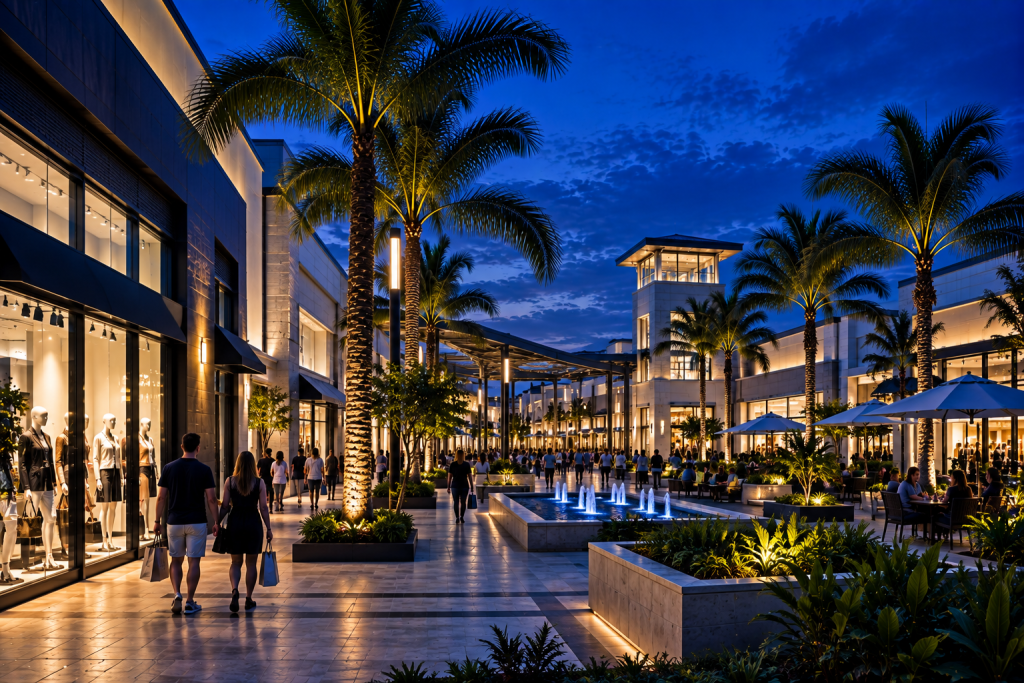
Retail Industry in Florida
The retail industry in Florida operates within one of the largest and most internationally connected state economies in the United States, supported by a rapidly changing population, major metropolitan markets, global tourism, extensive shopping infrastructure and important trade connections with Latin America, the Caribbean and the wider world. Miami and South Florida provide an internationally recognised retail market combining luxury brands, shopping centres, tourism and international commerce, while Orlando, Tampa, Jacksonville, Fort Lauderdale, West Palm Beach and other cities create substantial regional markets of their own. Behind these consumer-facing environments is a much wider B2B ecosystem involving retail installation companies, transport and logistics providers, manufacturers, suppliers, warehouse operators, technology specialists and contractors responsible for building, supplying and maintaining physical retail locations.

Florida’s geography and economic structure make its retail market particularly diverse. Miami can support international luxury flagships and premium shopping destinations, Orlando combines a large resident population with enormous visitor activity, and Tampa Bay continues to develop as a major metropolitan and distribution market. Jacksonville’s location in northeast Florida gives it an important role in transport and logistics, while South Florida’s ports, airports and warehouse infrastructure connect retailers with international supply chains. Retail activity also extends throughout coastal communities, suburban growth corridors and smaller regional centres.
Tourism adds another dimension. Florida attracts visitors from across the United States and internationally, generating retail demand within shopping centres, outlet destinations, entertainment districts, airports, resorts and tourist-oriented commercial environments. This creates opportunities not only for retailers but also for the companies manufacturing, transporting and installing the physical infrastructure required to support them.
The wider retail industry in Florida therefore extends far beyond stores themselves. Every new location or refurbishment can involve designers, fixture manufacturers, freight companies, warehouses, installers, technology providers and maintenance specialists. Understanding these relationships is essential for businesses seeking to participate in Florida’s retail economy and for international organisations looking for partners capable of supporting projects within the state.
The Florida Economy and Retail Market
Florida has one of the largest state economies in the United States, supported by tourism, real estate, construction, financial and professional services, healthcare, aerospace, international trade, logistics, technology and a substantial consumer sector. Population growth has also expanded demand across many metropolitan areas, contributing to continuing investment in residential development, shopping, hospitality and commercial infrastructure.
The state’s retail market includes almost every major format. Supermarkets, shopping centres, outlet malls, luxury boutiques, department stores, home-improvement retailers, automotive showrooms, pharmacies, fashion stores, electronics retailers, restaurants and specialist businesses operate alongside independent stores and local concepts. Different parts of Florida support different combinations of these formats according to demographics, tourism and regional economic conditions.
South Florida has particularly strong international connections. Consumers and businesses maintain relationships throughout Latin America and the Caribbean, while Miami functions as an important commercial gateway between the United States and international markets. This can influence everything from product selection and luxury retail to logistics, distribution and international business development.
Florida’s climate and weather conditions also affect physical retail operations. High temperatures, humidity, intense rainfall and severe weather risks can influence buildings, transport schedules, storage conditions and project planning. Businesses supplying fixtures or technology need to consider how equipment will be stored, transported and installed, while retailers may need contingency planning when refurbishment or rollout programmes coincide with disruptive weather.
Miami and Florida’s Major Retail Cities
Miami is the most internationally visible market within the retail industry in Florida. The wider Miami metropolitan area combines luxury retail, fashion, hospitality, tourism, international commerce and significant consumer spending. Areas such as the Miami Design District have become associated with luxury fashion and design, while major shopping destinations throughout Miami-Dade and Broward counties serve both residents and international visitors.
Miami’s role extends beyond consumer retail. International companies use South Florida for commercial relationships across Latin America and the Caribbean, and the region’s ports, airports, warehouses and freight businesses support extensive international trade. This combination makes Miami relevant to retailers, manufacturers and project organisations looking for both a US market and a connection with wider international supply chains.
Orlando provides a different commercial environment. Its global tourism industry creates enormous visitor flows alongside a substantial local population. Outlet shopping, destination retail, entertainment-related stores, shopping centres and hospitality environments all contribute to the market. Retail projects can therefore range from conventional stores to highly specialised environments connected with tourism and entertainment.
Tampa and the wider Tampa Bay region provide another growing metropolitan market with significant retail, distribution and logistics activity. Jacksonville combines a large population with strategic transport connections in northeast Florida, while Fort Lauderdale and West Palm Beach contribute to the broader South Florida economy. For retailers operating statewide, these cities create a geographically dispersed network requiring coordinated logistics, installation and maintenance coverage.
Shopping Districts, Shopping Centres and Retail Parks
Florida contains a particularly broad selection of shopping environments, from luxury districts and enclosed malls to outlet centres, open-air lifestyle developments, retail parks and suburban shopping centres. The state’s climate allows extensive use of outdoor commercial environments, while tourism supports destination shopping that can attract customers far beyond the immediate local population.
These formats create different requirements for retail installation. Premium stores can involve bespoke furniture, specialist lighting, stone, glass, metalwork, digital technology and carefully controlled finishes. Outlet stores and national chains may use more standardised fixture packages designed for efficient deployment across multiple locations. Large-format stores can require substantial quantities of shelving, signage and customer-facing equipment.
Shopping centres and managed developments also impose operational requirements on contractors. Deliveries may need to use designated loading areas, installation teams can require advance approval and disruptive work may be restricted outside trading hours. Large fixtures need to fit through the complete access route between the vehicle and final installation position.
Retail parks and freestanding stores can provide easier loading access, but the quantity of equipment can be much greater. Understanding the individual site therefore remains essential. Store dimensions, access, working hours, available storage and installation sequence should ideally be established before fixtures leave the warehouse.
Retail Installation and Store Development
Professional retail installation supports new store openings, refurbishments, relocations, rollouts and ongoing retail maintenance throughout Florida. Installation work can include shelving, counters, furniture, branded displays, signage, graphics, digital screens, kiosks, technology equipment and specialist fixtures manufactured either within the United States or internationally.
Florida’s large number of national and international retailers creates significant potential for multi-site programmes. A brand may need to install the same display across Miami, Orlando, Tampa and Jacksonville while maintaining identical visual and technical standards. The physical distance between these locations means transport and installation planning need to operate together.
Refurbishments create continuing work throughout established retail estates. Stores can remain commercially successful for many years while their interiors change repeatedly. Furniture becomes worn, brands introduce new concepts, digital technology replaces older equipment and merchandising layouts evolve. Existing fixtures may therefore need to be dismantled and removed before replacement installations begin.
Many projects take place outside trading hours because retailers want to minimise disruption. Installation teams may work overnight and return the store to trading condition before opening. This creates a limited working window and makes preparation particularly important. Equipment needs to arrive complete, access must be confirmed and unexpected site conditions need to be resolved quickly if the programme is to remain on schedule.
Transport and Logistics Infrastructure
Florida’s transport and logistics infrastructure connects its major metropolitan markets with the wider United States and international trade routes. Interstate highways provide important north-south and east-west connections, while ports, airports, rail networks and extensive warehousing support both consumer distribution and commercial projects.
The state’s elongated geography creates particular considerations for statewide retail programmes. Miami and Jacksonville are separated by a substantial distance, while Tampa and Orlando create additional central Florida routes. A project covering the entire state therefore needs realistic travel and transport planning rather than treating Florida as a single compact metropolitan area.
Specialist retail transport also differs from conventional freight. Finished furniture, glass, signage, electronics and bespoke displays can require protective handling because cosmetic damage can make an otherwise functional component unacceptable inside a customer-facing environment. Store-specific equipment also needs accurate identification so components are delivered to the correct location.
Coordination with installation teams can significantly improve project efficiency. Equipment arriving days before it is required can create storage problems, while late deliveries can leave installers waiting. For complex projects, phased deliveries allow equipment to reach the store according to the installation sequence and reduce congestion inside the working environment.
Ports, Airports and International Trade
Florida’s ports give the state an important role in international commerce. Port Miami and Port Everglades provide major connections for containerised cargo and trade with Latin America, the Caribbean and other international markets, while ports including Jacksonville and Tampa contribute additional freight capacity and regional connections.
For the retail supply chain, these gateways can handle consumer products as well as fixtures, displays and equipment manufactured internationally. A store package produced overseas may arrive through a Florida port before moving through customs, warehousing, inspection, allocation and final delivery.
Florida’s airports add another layer of connectivity. Miami International Airport is an important international cargo gateway, while Orlando, Tampa and other airports provide additional passenger and freight connections. Air cargo can be particularly valuable for high-value technology, prototypes or urgent replacement components needed to protect a fixed store opening.
International manufacturers entering the retail industry in Florida therefore need to think beyond the journey into the United States. Equipment still needs to move from the port or airport through domestic logistics networks and ultimately into the store. Freight forwarding, warehousing, final-mile transport and installation are connected stages of the same commercial process.
Warehousing and Distribution Hubs
Warehousing is increasingly important throughout Florida as population growth, e-commerce and international trade create greater demand for distribution infrastructure. South Florida supports extensive warehouse activity serving Miami-Dade, Broward and Palm Beach counties, while Central Florida provides strategic distribution access around Orlando and the Interstate 4 corridor. Jacksonville and Tampa add important regional logistics capacity.
Retail project warehousing can involve considerably more than storing pallets. Fixtures from several manufacturers may need to be received separately and consolidated into complete store packages. Equipment can be checked for transport damage, labelled by project and released according to installation schedules.
For large rollouts, accurate inventory control becomes essential. Hundreds of stores can require thousands of similar components, and an allocation mistake at warehouse level can create problems at multiple sites. Identifying shortages before dispatch gives project managers an opportunity to arrange replacements before installation teams arrive.
Warehouses can also support maintenance and reverse logistics. Spare fixtures and components can be retained for future repairs, while equipment removed during refurbishments can return for assessment, refurbishment, redistribution or recycling. This allows retailers to manage physical assets across their estates rather than treating every store project as an isolated event.
Manufacturing and the Florida Retail Supply Chain
Florida has manufacturing activity across aerospace, food and beverages, medical technology, electronics, building products, marine industries, fabricated products and numerous specialist sectors. Retail projects also draw extensively on manufacturers elsewhere in the United States and internationally, creating a supply chain that can involve numerous production locations before equipment reaches Florida.
Retail fixture manufacturing can combine timber products, metalwork, glass, plastics, graphics, lighting and electronic technology. Some projects use standard modular systems, while luxury and flagship stores may require highly bespoke components manufactured specifically for a single location.
Manufacturers need to consider what happens after production. A large fixture may be straightforward to assemble in a factory but difficult to move through a shopping-centre service corridor. Packaging that protects a product during long-distance freight can still create installation delays if components are difficult to identify or unpack on site. Collaboration between manufacturing and installation teams can therefore improve future designs and reduce recurring problems.
The Global Retail Directory is designed to improve visibility between these parts of the industry. Manufacturers and suppliers can present their capabilities to retailers and project organisations, while companies producing equipment outside Florida can identify installation and logistics businesses capable of supporting their projects within the state. This structured visibility becomes particularly useful when businesses enter unfamiliar geographic markets.
Florida Retailers and Iconic Brands
Florida’s consumer market supports major American and international brands across fashion, beauty, technology, sportswear, automotive, grocery, hospitality and luxury retail. The state also produces and develops businesses of its own, while Miami’s international character creates particularly strong connections with brands operating across Latin America and the Caribbean.
Luxury retail is especially visible within South Florida. International fashion and jewellery houses operate alongside premium hospitality, restaurants, galleries and design businesses, creating commercial environments where the physical quality of a store forms an important part of brand positioning. Orlando’s tourism economy generates a different type of branded retail activity, while national chains operate extensively throughout suburban and regional markets.
For Global Retail Directory, Iconic Brands have a different role from commercial supplier categories. They represent the consumer-facing organisations around which wider B2B ecosystems develop. Opening or refurbishing a branded store can create requirements for architects, designers, manufacturers, suppliers, transport companies, warehouse operators, installation contractors, technology specialists and maintenance providers.
Florida’s international connections make these relationships particularly interesting. A brand operating stores in Miami may also operate throughout Latin America, Europe or Asia, while manufacturers and contractors supporting that brand can potentially develop relationships beyond a single state. The physical retail environment therefore becomes part of a much wider international commercial network.
Digital Retail and Omnichannel Development
Digital commerce is firmly integrated into the retail industry in Florida, with consumers moving continuously between websites, mobile applications, marketplaces and physical stores. Customers may research products online before visiting a location, purchase digitally for collection, arrange home delivery or return online purchases through a physical store.
This development changes the role of retail property. Stores can function simultaneously as sales environments, showrooms, service centres, collection locations and local fulfilment points. Retailers consequently continue investing in physical environments even while expanding their digital capabilities.
Technology inside stores is developing alongside these changes. Digital signage, self-service systems, interactive displays, connected inventory technology and sophisticated payment infrastructure increasingly operate alongside traditional furniture and merchandising systems. Installation teams therefore need to coordinate physical fixtures with power, data and technology requirements.
Omnichannel retail also changes logistics. Inventory can move between distribution centres, stores and consumers through multiple routes, while returns create reverse flows through the same network. Florida’s warehouse and transport infrastructure consequently supports both traditional store distribution and increasingly integrated digital fulfilment.
Business Culture and Working Practices
Companies undertaking retail projects in Florida need to understand the commercial, contractual and regulatory environment within the United States as well as requirements specific to individual sites and local jurisdictions. Permits, contractor requirements, insurance, safety procedures and building rules can vary according to the scope of work and location.
Shopping centres, airports, resorts and other managed environments can impose additional contractor procedures. Installation businesses may need advance documentation, authorised working periods and coordination with security or facilities management before accessing the site.
Clear scopes are particularly important during multi-site programmes. Travel, accommodation, waiting time, failed visits, additional works and damaged equipment can create substantial costs when responsibilities are not established before work begins. Consistent reporting helps project managers identify whether an issue is isolated to one store or represents a recurring problem affecting the wider rollout.
International organisations should also consider time zones, communication and documentation. Design teams or manufacturers may operate in Europe or Asia while Florida contractors work locally. Accurate drawings, installation instructions, schedules and photographic reporting help these geographically separated teams maintain control of the project.
Opportunities for International Retail Companies
Florida offers significant opportunities for international businesses operating across retail installation, logistics, manufacturing, supply and technology. Its population, tourism economy and international commercial connections make the state an attractive market for brands entering or expanding within the United States.
Miami is particularly relevant to businesses with interests across Latin America and the Caribbean. Companies can use relationships developed in South Florida as part of wider regional strategies, while logistics networks provide connections between the United States and international markets.
International manufacturers supplying retail equipment do not necessarily need to create their own complete operational infrastructure within Florida. Partnerships with local warehouses, transport providers and installation companies can provide the final stages required to deliver projects. Similarly, international project-management businesses can maintain central control while specialist local companies complete physical work.
Discovery remains one of the challenges. A manufacturer may know it needs installation coverage in Florida without knowing which companies specialise in its particular type of equipment. A Florida logistics business may have valuable experience handling high-value retail fixtures but remain difficult for an overseas company to identify. A specialist installer may be capable of supporting national or international programmes but primarily be visible within existing customer networks. Improving structured visibility between these businesses can create opportunities for new partnerships.
Connecting the Florida Retail Industry Through Global Retail Directory
The Global Retail Directory is designed to connect businesses operating throughout the international retail ecosystem. Within Florida, retail installation companies, transport and logistics providers, manufacturers and suppliers can present their capabilities to organisations searching for specialist support, while companies elsewhere in the United States and internationally can discover businesses capable of supporting projects across the state.
Florida’s geographic and commercial position makes these connections particularly relevant. An international manufacturer shipping equipment through Miami may require warehousing, final-mile transport and installation support. A retailer planning locations across Miami, Orlando, Tampa and Jacksonville may need companies capable of coordinating multiple stages of the project. Florida businesses can simultaneously use international visibility to develop relationships with retailers, manufacturers and project organisations outside the state.
Iconic Brands provide the wider context by representing the consumer-facing companies around which these commercial ecosystems develop. Behind every successful store environment sits a network of manufacturers, suppliers, logistics businesses, installers and technical specialists whose work is rarely visible to the customer but remains essential to physical retail.
As the retail industry in Florida continues to develop through population growth, tourism, international trade, omnichannel commerce and investment in physical stores, the ability to identify appropriate specialist partners will remain important. Connecting installation, transport and logistics, manufacturing, supply and brands within a global industry network can help companies build commercial relationships and support retail projects across Florida, the wider United States and international markets.