
Retail Industry in Egypt
The retail industry in Egypt operates within one of Africa and the Middle East’s largest consumer markets, shaped by a population exceeding 100 million people, the enormous commercial influence of Cairo, a substantial domestic manufacturing base and a geographic position connecting Africa, Asia, the Mediterranean and the Middle East. Modern shopping centres and international brands operate alongside neighbourhood businesses, traditional commercial districts and independent retailers, creating several different forms of commerce within the same economy.

Egypt’s importance extends considerably beyond domestic consumption. Textiles, apparel, food, furniture, packaging and other products are manufactured within the country, while Alexandria and other maritime infrastructure connect Egyptian businesses with international trade. Tourism creates another commercial economy across Cairo, Luxor, Aswan, the Red Sea and Mediterranean destinations, while the Suez Canal places Egypt directly beside one of the most important international shipping routes connecting Asian and European markets.
For the Global Retail Directory, Egypt demonstrates why retail needs to be understood as a complete ecosystem. Manufacturers & Suppliers, Retail Installation Companies, Transport & Logistics businesses and growing Iconic Brands all contribute to the market in different ways. Egypt’s long-term opportunity is not simply to sell more products domestically but to connect its manufacturing, geographic position, consumer scale and specialist capabilities with businesses throughout several major commercial regions.
Cairo Combines Extraordinary Consumer Scale with Several Forms of Retail
Understanding Egyptian retail begins with Cairo, where the wider metropolitan region contains an enormous concentration of consumers, businesses, universities, government institutions and corporate headquarters. Contemporary shopping centres serve customers looking for fashion, electronics, beauty, food and entertainment, while supermarkets and hypermarkets provide organised grocery retail and countless independent businesses serve residential communities throughout the city.
Traditional commerce remains equally important. Dense commercial streets and specialist markets demonstrate that modernisation does not necessarily eliminate established retail structures, and businesses selling textiles, jewellery, household goods, food and furniture can operate within long-established commercial ecosystems. Cairo therefore contains several retail economies simultaneously, serving different incomes, purchasing habits and customer expectations rather than one standardised metropolitan consumer.
For international brands, this complexity makes location and local understanding fundamental. A premium store within a modern development operates under completely different commercial and physical conditions from an independent business within a dense traditional district. GRD can help international companies identify Egyptian suppliers and Retail Installation Companies capable of translating global concepts into the practical realities of Cairo rather than treating the city simply as one enormous undifferentiated market.
Modern Shopping Centres Are Creating New Consumer Destinations
Egypt’s modern shopping-centre sector has changed the physical retail landscape, particularly around Greater Cairo and newer urban developments. These destinations increasingly combine stores with restaurants, cinemas, entertainment, services and leisure, encouraging customers to spend several hours within one environment rather than arriving solely to complete a specific purchase.
Every development creates substantial B2B demand behind the visible customer experience. Retail units require flooring, lighting, furniture, displays, electrical infrastructure, graphics and technology, while restaurants introduce commercial kitchens and specialist equipment. Stores also need refurbishment as brands change concepts, meaning the commercial opportunity continues long after the original shopping centre has opened.
For Egyptian manufacturers and contractors, these projects provide opportunities to develop capabilities relevant to increasingly sophisticated retail environments. International brands require consistent standards, but local manufacturing and installation can provide shorter lead times and easier maintenance when suitable suppliers exist. The growth of organised retail can therefore strengthen Egypt’s B2B commercial sector as well as create additional places for consumers to shop.
Egyptian Cotton and Textiles Connect Agriculture with International Retail
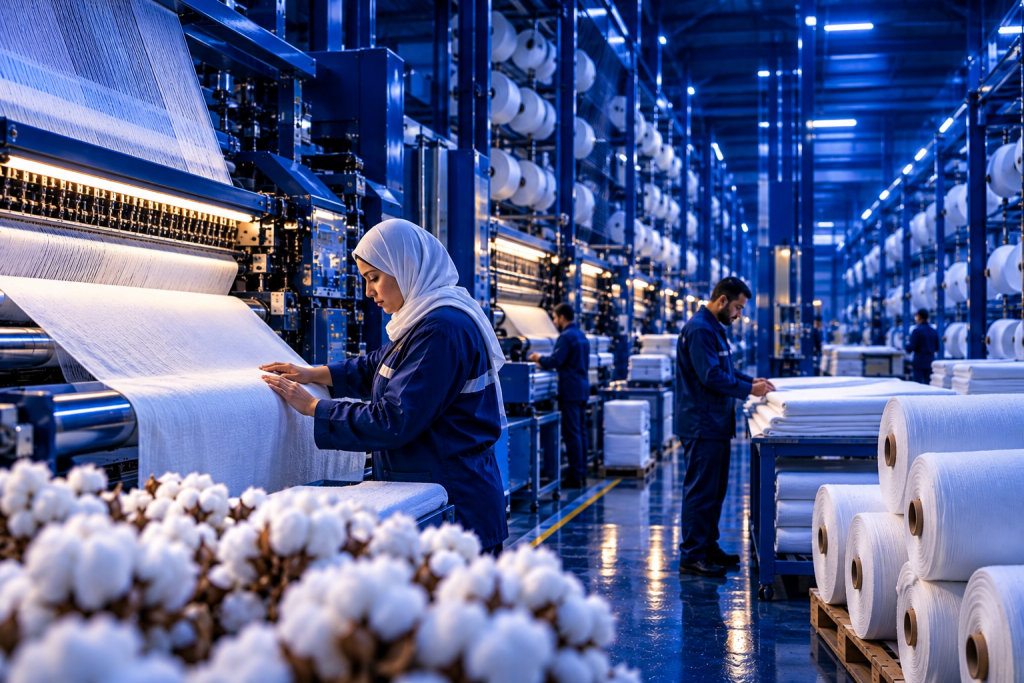
Few materials are associated internationally with Egypt as strongly as cotton, and its journey toward the consumer demonstrates how value can accumulate throughout a retail supply chain. Cotton can leave the country as an agricultural commodity, or it can be spun into yarn, woven into fabric, manufactured into bedding, towels or clothing, packaged and eventually sold under a consumer brand. Each additional stage creates opportunities for different Egyptian businesses.
Egypt’s textile and apparel industry gives the country an existing foundation for moving further along this value chain. Manufacturers can produce garments, fabrics and home textiles for domestic and international customers, while geographic proximity to European markets can become commercially useful where retailers value shorter lead times and sourcing diversification alongside production cost. Egypt does not need to replace distant manufacturing markets to benefit; it can become another strategically useful option within more diversified supply networks.
The larger opportunity is to connect manufacturing capability with branding and retail. An Egyptian textile factory can manufacture for overseas customers without consumers knowing its name, but design, packaging, marketing and e-commerce create the possibility of developing finished products under Egyptian brands. For GRD’s Manufacturers & Suppliers and Iconic Brands, this progression demonstrates how agricultural resources can ultimately support internationally recognised consumer businesses.
Food Manufacturing and Grocery Create a Large B2B Ecosystem
Food represents another enormous part of Egypt’s consumer economy because a large population creates constant demand for packaged foods, beverages, dairy products, fresh products and household staples. Domestic processing and manufacturing therefore support not only consumers but packaging businesses, refrigeration suppliers, warehouses, logistics companies and technology providers operating throughout the grocery supply chain.
Supermarkets and hypermarkets are changing how these products move. Large organised networks can use central purchasing and distribution rather than depending entirely on fragmented store-level deliveries, increasing efficiency while placing greater demands on suppliers. Products need consistent quality, packaging, barcodes and delivery performance, while refrigerated and frozen categories require reliable temperature control throughout storage and transportation.
The supermarket itself also represents a technically demanding physical environment. Refrigeration, shelving, checkout systems, lighting, security, food preparation and digital technology all need to operate together while substantial quantities of inventory move through the back of the store. The customer experiences an ordinary grocery trip, but behind it sits an extensive B2B system demonstrating why food retail extends far beyond the businesses whose names appear above supermarket entrances.
Alexandria and the Suez Canal Connect Egypt with Global Commerce
Alexandria provides Egypt with a commercial identity different from Cairo through its Mediterranean location, substantial population and long-standing connection with maritime trade. Ports and surrounding logistics infrastructure allow imported products, raw materials and machinery to enter Egyptian supply chains while domestic products travel outward toward international markets. Manufacturing therefore connects with maritime trade long before consumers encounter the finished product.
The Suez Canal gives Egypt an even more unusual geographic position because international maritime traffic between Asia and Europe passes directly through Egyptian territory. Consumer electronics, clothing, furniture, machinery, materials and countless other products destined for retail markets can move along this route. Transit itself does not automatically transform Egypt into a manufacturing or distribution centre, but proximity creates possibilities for businesses capable of developing commercial activity around these international movements.
For GRD’s Transport & Logistics businesses, this geographic position is particularly relevant. Egypt has the potential to participate through warehousing, processing, manufacturing, consolidation and distribution rather than simply sitting beside international shipping. Connecting those logistics capabilities with domestic manufacturers can strengthen Egypt’s role within international retail supply chains and make its location commercially valuable beyond the canal itself.
Egypt Can Connect European, Middle Eastern and African Markets
Egypt occupies a position between several enormous consumer regions. Europe lies across the Mediterranean, Gulf and Middle Eastern markets are connected through regional trade, and Africa represents a vast collection of developing consumer economies. Egyptian businesses therefore have several possible directions for international expansion without needing to move immediately from domestic operations into distant global markets.
Regional expansion can provide valuable experience. Products developed for Egyptian consumers may also find customers elsewhere in North Africa or the Middle East, although regulations, purchasing power and consumer preferences still differ between countries. Manufacturers learn about export documentation and logistics, while consumer brands develop experience adapting marketing and distribution to unfamiliar markets.
This geographic position can also attract international businesses looking for regional partners. Egypt can function as a consumer market, production location and commercial base depending on the company’s requirements. Global Retail Directory can support these relationships by allowing businesses to discover Egyptian capabilities according to what companies manufacture, supply or deliver rather than viewing Egypt only through its domestic retail market.
Furniture and Craftsmanship Give Egypt Additional Manufacturing Opportunities
Egypt has a long tradition of furniture production, woodworking, textiles, metalwork, jewellery, ceramics and decorative craftsmanship. These capabilities can serve residential consumers, hospitality and physical retail, while distinctive materials and craft skills can provide products with an identity difficult to reproduce through completely standardised mass manufacturing.
Commercial furniture introduces different requirements from individual domestic products. A retailer opening multiple locations needs consistent dimensions, finishes and repeatable manufacturing, while fixtures need packaging capable of protecting them through transportation and installation. Manufacturers that develop these systems can move from local production into commercial programmes serving retailers, hotels and hospitality businesses across Egypt and potentially throughout the wider region.
Craft businesses face a similar opportunity from another direction. Traditional skills can remain central to the product while packaging, inventory, e-commerce and international fulfilment become increasingly professional. Premium retail can provide a route through which Egyptian craftsmanship reaches customers internationally without requiring the production method itself to lose the characteristics that make it distinctive.
Tourism Creates a Separate Retail and Hospitality Economy
Tourism adds another major dimension to Egyptian commerce because Cairo, Luxor, Aswan, the Red Sea and Mediterranean destinations attract visitors for very different experiences. Tourists create demand for food, fashion, jewellery, beauty, crafts and gifts while hotels, restaurants and resorts generate extensive commercial requirements behind the scenes.
Physical retail can provide Egyptian brands with international exposure before they establish permanent operations overseas. A visitor discovering a local product during a holiday can continue purchasing after returning home if the business has effective e-commerce and international fulfilment. The original tourist transaction can therefore become the beginning of a longer customer relationship rather than a one-time purchase.
The Red Sea demonstrates how closely retail and hospitality can overlap. Resorts need furniture, lighting, signage, technology, food-service equipment and maintenance while their guests create demand for boutiques, convenience stores and lifestyle products. Manufacturers and suppliers serving these environments participate in the retail ecosystem even when the final project is described primarily as hospitality.
Cairo’s Urban Expansion Is Creating New Retail Geography
Greater Cairo continues to expand geographically as new residential and commercial developments create consumer markets beyond established central districts. Retail follows population, meaning shopping centres, supermarkets, restaurants, healthcare, services and other consumer businesses develop around communities as housing and infrastructure expand.
For retailers, this changes how property strategy should be approached. Evaluating Cairo solely through established shopping districts can overlook areas where future consumer demand is developing rapidly. New communities can create opportunities for businesses capable of entering before locations become fully mature, but they also require careful understanding of population growth, infrastructure and the surrounding competitive environment.
This expansion creates opportunities throughout the B2B retail sector as well. New stores need fixtures and technology, commercial properties require maintenance and expanding networks need distribution capable of serving locations across an increasingly dispersed metropolitan area. Egyptian Manufacturers & Suppliers and installation businesses can therefore benefit from urban development long before individual areas reach their eventual consumer scale.
Climate Influences How Egyptian Stores Need to Be Designed
Egypt’s climate creates practical requirements for shopping centres, supermarkets, stores and hospitality environments. Cooling represents a significant operating consideration during hot periods, making energy efficiency commercially important as well as environmentally relevant. Lighting can also contribute heat, meaning efficient systems can reduce both direct electricity consumption and the cooling required to maintain comfortable environments.
Materials need to perform reliably under local conditions, particularly where equipment or commercial environments are exposed to strong sunlight, heat or outdoor conditions. Specifications developed for cooler climates may therefore require adaptation, even when the visual identity of an international brand remains unchanged.
For manufacturers and Retail Installation Companies, understanding these conditions can become a competitive advantage. Good store delivery is not simply about reproducing drawings; it involves ensuring the finished environment works reliably where it is actually located. International standards and local engineering therefore need to complement one another rather than compete.
E-Commerce and Digital Payments Are Expanding Retail Access
Digital commerce gives Egyptian businesses access to customers beyond their immediate neighbourhoods. A fashion company based in Cairo can sell nationally without opening stores throughout the country, while craft businesses and specialist producers can potentially reach international buyers. Social media provides another route to product discovery, reducing some of the barriers smaller companies historically faced when attempting to build consumer awareness.
Digital growth nevertheless creates substantial physical requirements. Products need inventory management, warehousing and packaging, orders need delivery and returns require processing. As sales volumes increase, logistics can become one of the most important operational challenges, demonstrating once again that e-commerce does not remove physical infrastructure from retail but increases the need for efficient infrastructure behind the digital interface.
Digital payments can gradually extend this modernisation to businesses of different sizes. Smaller merchants able to accept electronic transactions can participate more easily in delivery platforms and digital commerce, while larger retailers can connect payment information with loyalty, inventory and customer systems. Technology becomes most valuable when it removes friction rather than simply appearing innovative.
International Brands Need Capable Egyptian Partners
Egypt’s population and urban scale make it attractive to international retailers, but market size alone does not guarantee commercial success. Pricing, product selection, property conditions and consumer behaviour all influence performance, while physical stores still need to be delivered and maintained within Egyptian buildings and commercial environments.
Furniture manufactured overseas needs transportation and installation, electrical and technology systems require local coordination and maintenance eventually becomes necessary. Where suitable domestic capability exists, selected fixtures or components can be manufactured locally, potentially reducing lead times and making replacements easier to obtain. International brands therefore benefit from identifying capable Egyptian manufacturers, project businesses and installation specialists rather than treating the market solely as a destination for imported products.
This relationship can eventually operate in both directions. Egyptian suppliers proving themselves on international brand projects domestically can use that experience when pursuing work elsewhere in the region. GRD can help make these businesses visible to retailers and project organisations searching for local execution combined with professional international standards.
Egypt Has Potential as a Nearshore Manufacturing Location
Supply-chain disruption has encouraged retailers and manufacturers to consider the risks of relying entirely on very distant production markets. Egypt’s proximity to Europe creates an opportunity in categories where manufacturing capability, lead time and responsiveness can provide commercial advantages, particularly textiles, apparel, furniture and selected consumer products.
Nearshoring does not mean every product should be manufactured closer to the customer. Production scale, materials, specialist capability and price all remain important, and global sourcing will continue to play a major role in retail. The opportunity for Egypt is to become part of a more diversified network in which retailers have several sourcing options rather than depending excessively on one region.
For Egyptian manufacturers, this creates a potential customer base considerably larger than domestic demand alone. Businesses capable of demonstrating consistent quality, reliable communication and professional delivery can compete through the complete commercial proposition rather than labour cost alone. Greater international visibility through GRD can help these manufacturers become discoverable to buyers actively evaluating alternative supply regions.
Sustainability Can Strengthen Egyptian Manufacturing Competitiveness
Energy, water, materials and waste are increasingly important considerations for manufacturers supplying international retailers. Buyers are asking more detailed questions about how products are made, while environmental requirements can become part of formal supplier qualification rather than remaining purely voluntary corporate commitments.
Textile manufacturing is particularly relevant because water, chemicals and energy can all represent significant environmental considerations. Factories investing in efficient machinery, better material utilisation, water management and waste reduction can potentially lower operating costs while improving their attractiveness to customers seeking more responsible supply chains.
Sustainability therefore creates pressure but also commercial opportunity. Egyptian manufacturers capable of documenting genuine improvements can differentiate themselves from competitors relying primarily on price. Environmental performance becomes strongest when it is integrated into manufacturing efficiency rather than added later as marketing language.
Connecting Egyptian Businesses Through Global Retail Directory
Egypt contains manufacturers, suppliers and commercial specialists capable of contributing to retail domestically and internationally, but visibility remains a significant challenge. A European retailer may not know which Egyptian textile producer matches its requirements, a Gulf project organisation may need furniture manufacturers and an international brand entering Cairo can require businesses capable of delivering physical stores.
The Global Retail Directory is designed to make these relationships easier to establish. Egyptian Manufacturers & Suppliers can present production capabilities, Retail Installation Companies can demonstrate where they operate, Transport & Logistics businesses can connect Egyptian production with regional and international markets, and growing Iconic Brands can represent the consumer-facing companies whose expansion creates opportunities throughout the wider ecosystem.
Egypt’s geographic position makes this international discovery particularly relevant. The country sits naturally between several major commercial regions, but geography creates only potential until businesses form actual relationships. GRD provides a structured platform through which international buyers can discover Egyptian capabilities and Egyptian companies can become visible beyond existing domestic or regional networks.
Egypt’s Retail Future Extends Far Beyond the Store
The future of the retail industry in Egypt will be influenced by population growth, urban development, technology, tourism and the continuing evolution of organised retail, but some of the country’s greatest opportunities exist behind the storefront. Egypt has agricultural resources, manufacturing capability, major cities, ports and a geographic position connecting several of the world’s most important commercial regions.
Cotton can become finished textiles and consumer brands, furniture manufacturers can supply commercial environments throughout the region, food producers can expand through modern grocery networks and digital commerce can give smaller Egyptian businesses access to customers they could never previously reach. Cairo provides extraordinary consumer scale, Alexandria connects the country with the Mediterranean, the Red Sea combines commerce with tourism and the Suez Canal places Egypt beside trade moving between Asia and Europe.
For Global Retail Directory, Egypt is therefore much more than a large consumer market. It has the potential to become an increasingly important manufacturing, sourcing, logistics and commercial bridge between continents. Connecting its brands, manufacturers, suppliers, logistics businesses and retail specialists with international buyers and project organisations can help turn Egypt’s geographic and industrial advantages into stronger long-term participation in the global retail ecosystem.