
Retail Industry in Italy
The retail industry in Italy is inseparable from the country’s international influence on fashion, design, craftsmanship, food, furniture, automotive culture and luxury. Italy is not simply a major European consumer market; it is also one of the countries that has helped define how premium products and physical retail environments are designed, manufactured and presented around the world. Milan’s fashion districts, Rome’s internationally recognised shopping streets, Florence’s connection with leather and craftsmanship and specialist manufacturing regions across northern and central Italy form parts of an unusually diverse commercial ecosystem.

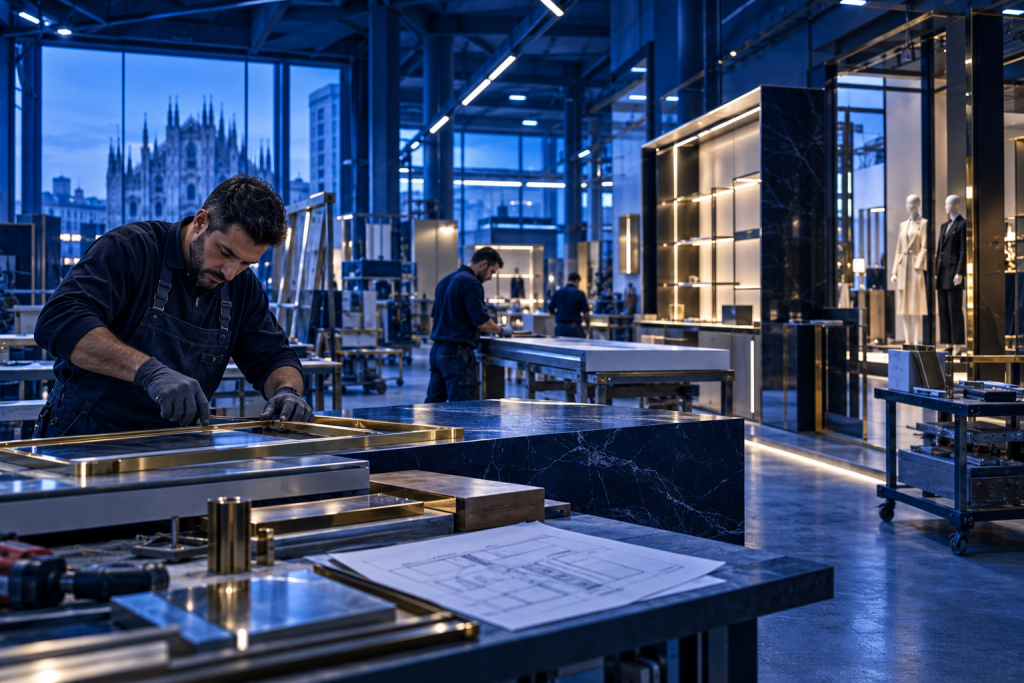
Behind Italy’s famous storefronts sits a much broader B2B industry. Furniture manufacturers, metalworkers, lighting companies, glass specialists, textile producers, architects, designers, logistics businesses, technology providers, installers and specialist workshops all contribute to retail environments within Italy and internationally. Many businesses producing components for stores operate within long-established manufacturing districts where specialist knowledge, suppliers and skilled workers have developed over generations, giving Italian companies capabilities that extend far beyond the consumer brands for which the country is best known.
For the Global Retail Directory, Italy demonstrates how closely consumer brands and specialist suppliers can be connected. A company searching the Italian market may be looking for a famous retailer, but it could equally need a manufacturer capable of producing bespoke furniture, a specialist working with premium materials, a logistics business supporting an international rollout or a Retail Installation Company capable of transforming a design concept into a finished store. Italy’s importance to global retail lies as much in what it creates for stores around the world as in what Italian consumers purchase domestically.
Milan Brings Fashion, Design and Retail Together
Milan occupies a distinctive position within European retail as one of the world’s major fashion and design centres. International luxury houses, Italian brands, designers, architects and specialist commercial businesses operate within the same metropolitan economy, while buyers, investors and visitors arrive from around the world. The Quadrilatero della Moda and streets such as Via Montenapoleone represent the internationally recognised side of Milanese retail, where physical stores frequently operate as statements about the brand rather than simply places where products are sold.
These environments demonstrate how architecture, materials, lighting, furniture, displays and customer service can combine into one commercial experience. A flagship boutique may generate direct sales, but it also communicates the brand to people passing through the city and provides a physical environment in which customers can understand products differently from the way they experience them online. For premium brands, the store can therefore become part showroom, part service environment and part global marketing asset.
Milan’s importance extends beyond the finished storefront because the wider region is connected with furniture, industrial design, exhibitions and manufacturing. A concept developed by a design studio in Milan can become a fixture manufactured elsewhere in Italy before being installed in London, Paris, Dubai, New York or Tokyo. This concentration of creative and production expertise gives manufacturers and specialist suppliers opportunities to participate in international retail programmes even when the final store is located far from Italy.
Italian Luxury Is Supported by an Extensive Industrial Ecosystem
Italian luxury is usually presented to consumers through finished products such as clothing, footwear, handbags, jewellery, furniture and automobiles, but behind those products sit extensive networks of specialist businesses. A luxury fashion company can depend on textile producers, leather suppliers, metal component manufacturers, packaging businesses and workshops whose names are largely unknown outside the B2B industry. Their expertise nevertheless contributes directly to the quality and identity associated with the final brand.
The same principle applies to physical stores. A premium boutique may contain stone, glass, polished metal, specialist timber, upholstery, lighting and bespoke furniture produced by several different companies. Every component needs the correct dimensions, finish and quality before arriving on site, and small imperfections that might receive little attention in a conventional commercial environment can become highly visible within luxury retail. Design ambition therefore needs equally strong manufacturing and project execution behind it.
This makes Italy particularly important within GRD’s Manufacturers & Suppliers ecosystem. The value of an Italian supplier is not always based on producing enormous volumes at the lowest possible cost; in many sectors it comes from specialist knowledge, material quality, design capability and the ability to manufacture technically demanding products. These companies can support international retailers across numerous markets from a single Italian production base, making B2B visibility as important as consumer recognition.
Craftsmanship Can Develop into International Manufacturing Capability
Italy contains thousands of smaller businesses whose specialist expertise contributes to much larger industrial supply chains. Some remain closely connected with traditional craftsmanship, while others have transformed generations of material knowledge into modern manufacturing operations capable of supplying international customers. Furniture, leather, textiles, ceramics, stone and metalwork all provide examples where advanced machinery can operate alongside processes still requiring skilled manual finishing.
This combination can be particularly valuable within retail projects. Bespoke commercial environments frequently require quantities too small for conventional mass manufacturing but specifications too demanding for purely decorative workshops. Specialist Italian manufacturers can occupy the space between these extremes, providing repeatable production while retaining the finishing quality and material knowledge required by premium brands.
The challenge is often not capability but international discovery. A family business can have decades of experience and exceptional technical knowledge while remaining known primarily through existing architects, designers and customers. Global Retail Directory is designed to help reduce this gap by allowing specialist Italian businesses to explain their capabilities directly to international buyers and project organisations searching for particular manufacturing expertise.
Rome and Florence Connect Retail with Heritage and Tourism
Rome creates a retail environment very different from Milan. Its enormous tourism economy, historic urban fabric and role as Italy’s capital bring international brands, Italian retailers, hospitality and traditional commerce together within one of the world’s most visited cities. Prime shopping streets around the historic centre accommodate luxury and international brands, while neighbourhood commerce and suburban retail serve a substantial resident population.
Historic properties create practical challenges for physical retail. Buildings were not designed around modern loading requirements, digital systems or large prefabricated fixtures, while narrow streets and protected architecture can restrict access. Surveying and installation planning therefore become particularly important, and fixtures may need to be manufactured in sections before final assembly inside the store. A globally consistent brand identity can still be achieved, but the process required to create it needs to respond to the local property.
Florence adds another dimension through its association with art, leather and craftsmanship. Tourism provides specialist retailers and premium brands with an international customer audience, while Tuscan leather and other regional skills support businesses selling products and components around the world. Rome and Florence together demonstrate how Italy’s cultural heritage can contribute commercially without preventing modern retail development, provided designers, manufacturers and Retail Installation Companies understand how to work sensitively within the physical environment.
Italy’s Manufacturing Districts Are a Major Retail Advantage
One of the most distinctive features of the Italian economy is the presence of regional manufacturing clusters where specialist knowledge has developed around furniture, textiles, footwear, ceramics, machinery, eyewear and numerous other industries. These clusters allow designers and manufacturers to work with networks of subcontractors and material specialists located relatively close to one another, creating ecosystems that can solve technically demanding production problems more efficiently than isolated businesses.
Northern Italy is particularly important to manufacturing and international trade, with Lombardy, Veneto, Emilia-Romagna and neighbouring regions containing substantial industrial capability. Furniture and interior production have obvious relevance to physical retail, while metalworking and engineering businesses can produce structures and specialist components. Lighting manufacturers contribute another capability because the way merchandise is illuminated can significantly influence both the appearance of products and the atmosphere of the store.
Many of these businesses may not describe themselves primarily as retail companies, yet their products and expertise can become essential components of commercial environments. This is one reason GRD defines the retail ecosystem broadly. A lighting manufacturer, stone processor, metal fabricator or specialist glass company can be highly relevant to an international retail project even if consumer-facing stores represent only one part of its customer base.
Store Design Connects Creative Ambition with Practical Execution
Italy’s influence on architecture and design creates particularly high expectations around physical presentation. This is visible not only in luxury fashion but in furniture showrooms, automotive environments, beauty stores, food retail and hospitality. Successful retail design needs to balance visual impact with commercial function, ensuring products remain accessible, staff have practical working areas and customers can move intuitively through the environment.
The strongest concepts also consider what happens after opening. Technology needs maintenance, displays need updating and furniture may eventually require repair or refurbishment. A store designed primarily for an opening photograph can become expensive and difficult to operate if maintenance access and daily use were not considered during development. Manufacturers and installers therefore contribute knowledge that can influence whether an ambitious design remains successful once customers and staff begin using it.
This relationship between creative concept and practical execution is particularly relevant in Italy because design ambition can be high. Designers, manufacturers, technology providers and installation teams need to communicate throughout the project rather than working as disconnected stages. GRD can help international organisations identify companies across these disciplines, creating opportunities for Italian expertise to contribute to retail environments well beyond the domestic market.
Furniture, Lighting and Materials Give Italian Suppliers Global Reach
Some of Italy’s strongest contributions to global retail happen through products consumers may never consciously notice. Lighting is a clear example because premium stores use it not simply to illuminate a room but to control attention, highlight merchandise and create atmosphere. Italian lighting design and manufacturing have strong international recognition, giving specialist suppliers opportunities to participate in stores throughout the world.
Furniture performs a similarly important role. Counters, shelving, display cabinets, tables and wall systems need to combine design quality with durability, manufacturability and practical installation. A successful fixture can be reproduced for locations across several continents, while premium projects may require bespoke pieces manufactured in relatively small quantities. Italian furniture companies can therefore serve both standardised rollout programmes and highly individual flagship environments.
Stone, ceramics, glass and specialist finishes provide another layer of Italian capability. Premium commercial interiors frequently use these materials for floors, walls, counters and decorative elements, connecting traditional industries with contemporary architecture. For GRD’s Manufacturers & Suppliers category, this demonstrates how broadly retail sourcing can extend: the business providing a distinctive material can be just as important to the finished environment as the company manufacturing the final counter.
Italian Brands Create International B2B Networks
Few countries have produced as many internationally recognised fashion, luxury and lifestyle brands relative to their size as Italy. These businesses operate flagship stores, boutiques, concessions and showrooms throughout the world, making Italy an exporter of retail concepts as well as products. When an Italian brand expands internationally, its growth creates commercial opportunities across numerous markets.
Furniture may continue to be manufactured in Italy while freight is coordinated internationally and final installation is completed by specialists within the destination country. Technology providers, property contractors and maintenance companies can become involved before and after opening, meaning one consumer-facing brand can connect dozens of B2B businesses across several countries. The brand remains visually consistent, but the infrastructure supporting it becomes international.
This is why Iconic Brands occupy a distinct but connected position within Global Retail Directory. Their role is different from businesses selling commercial services, yet their expansion creates demand throughout the supply chain. GRD can help show these relationships more clearly by connecting brands with manufacturers, logistics providers and retail installation specialists capable of supporting international growth.
Food Retail Represents Another Side of Italian Commercial Identity
Fashion and luxury dominate international perceptions of Italian retail, but food is equally important to the country’s commercial identity. Supermarkets, neighbourhood food stores, markets, restaurants and specialist producers create a vast domestic ecosystem, while Italian food brands have enormous international recognition. Physical retail and hospitality provide environments where food, culture and tourism frequently overlap.
Food environments also have different technical requirements from fashion stores. Refrigeration, food-safe materials, storage, service counters, preparation areas and high customer turnover influence design and equipment decisions, while distribution needs to maintain product quality throughout the supply chain. At the premium end, food halls and branded stores can combine retail with restaurants, demonstrations and customer experiences, making the physical environment part of how the product is understood.
Italian food businesses can use the same progression seen in fashion and other consumer categories: production can develop into branding, domestic recognition can become international distribution and physical concepts can eventually expand into other countries. This creates opportunities for packaging companies, refrigeration suppliers, logistics businesses and commercial contractors as the consumer brand grows.
E-Commerce Is Making the Italian Store More Sophisticated
Digital commerce has changed how Italian consumers discover and purchase products, but it has not removed the importance of physical stores in sectors where experience, service and presentation influence buying decisions. Luxury fashion provides an obvious example because customers can research products online before visiting a boutique or encounter something physically before completing the purchase through a digital channel later.
Stores consequently perform more functions than simply processing transactions. They can operate as showrooms, service locations, collection points, return destinations and marketing environments while providing the sensory and human experiences digital channels cannot fully reproduce. This means the commercial value of the store needs to be considered across the complete customer relationship rather than measured only through sales completed at the checkout.
Technology is becoming increasingly integrated into these spaces through digital displays, connected inventory, mobile payments and customer-management systems. Furniture may need to accommodate cabling and equipment without making it visually dominant, while systems need to remain accessible for maintenance. The physical store is therefore not becoming simpler because of e-commerce; in many cases it is becoming more technically complex and creating additional opportunities for specialist manufacturers and technology suppliers.
Moving Italian Retail Expertise Around the World Requires Coordination
Italy’s international retail influence depends on the ability to move products, fixtures and expertise beyond its borders. A piece of furniture manufactured near Milan may be destined for a store in Paris, London, Dubai or New York, requiring packaging appropriate to its materials, accurate component identification and documentation allowing another team to understand how it should be assembled after arrival.
For highly bespoke products, quality control before dispatch is particularly important because discovering a manufacturing problem after equipment has travelled internationally can create delays far more expensive than correcting the issue at the factory. Manufacturers therefore need to understand transportation and installation requirements, while destination teams need to provide useful feedback when recurring design or production difficulties appear.
This creates a natural connection between Italian Manufacturers & Suppliers, international Transport & Logistics businesses and local Retail Installation Companies. International projects work best when every participant understands that its responsibility extends beyond completing one isolated task. GRD can help create visibility across these categories so that businesses supporting global retail programmes can identify one another more efficiently.
Sustainability Can Build on Italy’s Tradition of Quality and Longevity
Italy’s traditions of high-quality manufacturing and craftsmanship can contribute naturally to a more sustainable approach to retail environments. Sustainability does not always require completely new materials or technologies; manufacturing fixtures that last longer, can be repaired and can adapt to changing store concepts can significantly reduce waste while protecting the retailer’s original investment.
Premium furniture can often be refinished rather than discarded, metal structures can accept new panels and lighting systems can be upgraded while retaining surrounding components. Stone and high-quality timber can remain useful across multiple refurbishments, while designing fixtures for disassembly makes it easier to replace damaged or outdated elements without removing the complete unit. These decisions can reduce both material waste and the cost of repeated store updates.
For Italian manufacturers already associated with quality and longevity, this represents a significant opportunity. Retailers increasingly examine the complete lifecycle of physical assets, meaning businesses capable of combining premium design with repairability and adaptability can strengthen their commercial proposition. Sustainability becomes most valuable when it is incorporated into the product itself rather than applied later as a marketing message.
Connecting Italian Businesses Through Global Retail Directory
Italy provides opportunities for international businesses both as a consumer market and as a source of specialist expertise. Retailers entering the country may require local design, manufacturing, technical and project partners, while businesses elsewhere can seek relationships with Italian brands or manufacturers whose products travel globally. The challenge is frequently not a lack of capability but finding the right company within a highly specialised industrial landscape.
A furniture manufacturer may be perfect for an international project but remain visible primarily to existing architects and customers. A designer may require a supplier with a particular stone, glass or metal capability without knowing which Italian company specialises in it. Likewise, an Italian brand expanding internationally may need logistics, installation and maintenance partners in markets where it has never previously operated.
The Global Retail Directory is designed to make these relationships easier to establish. Italian Manufacturers & Suppliers, Retail Installation Companies, Transport & Logistics businesses and Iconic Brands can become visible within one international platform while retaining their different roles within the industry. The objective is to make capability easier to discover across borders rather than leaving valuable commercial relationships dependent entirely on existing networks.
Italy’s Influence on Global Retail Extends Far Beyond the Store
The future of the retail industry in Italy will be shaped by digital commerce, changing consumer expectations, sustainability, technology and the continuing need for physical stores to provide experiences that justify a customer’s visit. Italy enters this period with advantages that are difficult to reproduce because its fashion and luxury brands have international influence, its manufacturing districts contain deep specialist expertise and its architects and designers contribute to commercial environments around the world.
The most interesting opportunities may emerge where these strengths overlap. A traditional manufacturer can become an international retail supplier, a craft technique can become part of a modern flagship environment and a domestic consumer brand can use digital commerce to build international demand before opening physical stores abroad. Food, furniture, automotive, fashion and lifestyle industries all provide different routes through which Italian products and capabilities can participate in international retail.
For Global Retail Directory, Italy demonstrates particularly clearly that retail is not one industry operating in isolation. It is a meeting point between design, manufacturing, technology, property, brands, craftsmanship, logistics and commerce. The opportunity for Italian businesses is therefore not simply to become more visible within Italy, but to show retailers, designers, manufacturers and project organisations around the world how Italian expertise can contribute to retail environments and supply chains anywhere in the global market.