
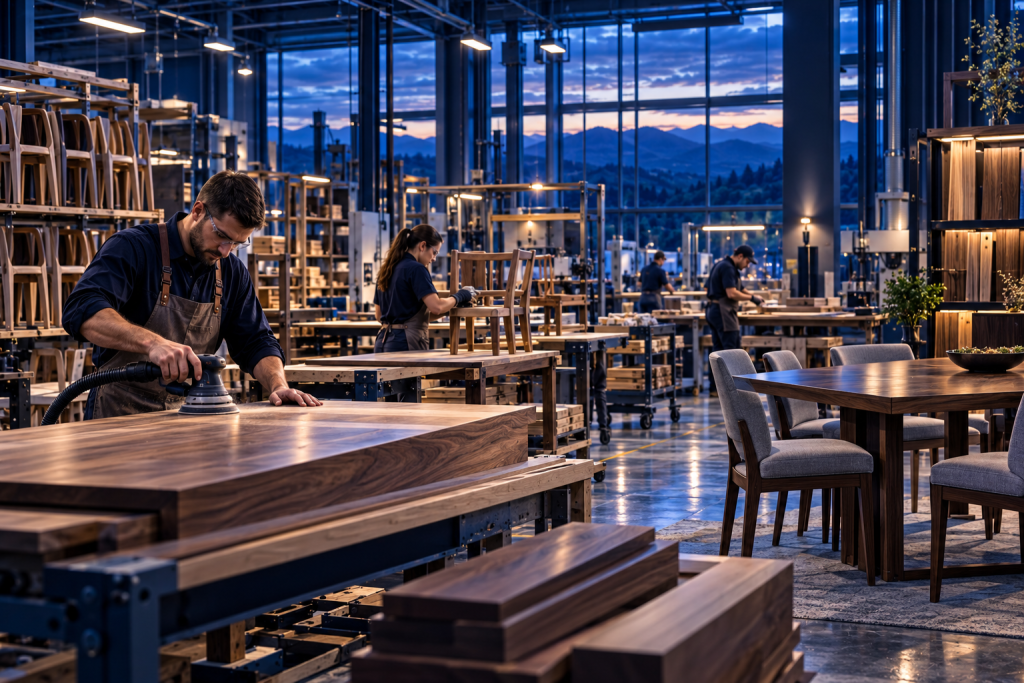
The retail industry in North Carolina combines one of America’s most established furniture manufacturing regions with a growing consumer economy, advanced manufacturing, international logistics and major commercial centres across the southeastern United States. Charlotte provides the state’s largest metropolitan retail market, while Raleigh, Durham, Greensboro, Winston-Salem and High Point contribute distinctive industries and business environments. North Carolina’s position along the Atlantic coast also connects domestic manufacturing and distribution with international trade, making the state an important part of the wider American retail supply chain.

North Carolina is particularly interesting because its manufacturing history remains closely connected to the products, materials and equipment used throughout modern retail. The state developed internationally recognised capabilities in furniture and textiles, while its contemporary economy includes pharmaceuticals, food processing, technology, machinery, packaging and advanced industrial production. High Point remains closely associated with the American furniture industry, Charlotte has become a major commercial and distribution centre, and the Research Triangle supports technology and specialist manufacturing businesses serving domestic and international customers.
For Global Retail Directory, North Carolina demonstrates how Retail Installation Companies, Manufacturers & Suppliers, Transport & Logistics businesses and Iconic Brands operate within one interconnected commercial ecosystem. Furniture manufacturers supply commercial interiors, logistics companies distribute products throughout the United States, installation specialists deliver physical retail environments, and established brands connect manufacturing capabilities with consumers. These relationships create opportunities for local businesses, national retailers and international organisations seeking commercial partners within the American Southeast.
Charlotte Is North Carolina’s Largest Retail and Commercial Market
Charlotte has developed into one of the southeastern United States’ major metropolitan economies, combining financial services, corporate activity, residential growth and a substantial consumer market. Its retail environment includes shopping centres, luxury boutiques, supermarkets, department stores, technology retailers, restaurants and independent businesses serving communities throughout the wider metropolitan region.
The city’s commercial geography creates different retail environments. Uptown Charlotte combines corporate activity, hospitality and urban retail, while SouthPark is associated with established shopping destinations and premium consumer brands. Suburban growth creates additional demand for supermarkets, convenience stores, restaurants and larger retail developments serving residential communities beyond the city centre.
For Retail Installation Companies, this expanding commercial environment creates opportunities involving store openings, refurbishments, furniture installation, signage, lighting and technology upgrades. Retailers operating across Charlotte and surrounding communities need reliable contractors capable of maintaining consistent standards across multiple locations. Local manufacturers and logistics providers can support these projects by supplying fixtures, equipment and coordinated deliveries.
High Point Is an International Centre of Furniture Manufacturing
High Point occupies a distinctive position within North Carolina’s economy because of its long association with furniture manufacturing, design and wholesale commerce. The city is internationally recognised for the High Point Market, a major furniture trade event that brings together manufacturers, designers, retailers and buyers from the United States and overseas.
The furniture industry extends far beyond residential products. Manufacturing capabilities involving timber, upholstery, metal components, finishing and specialist joinery can also support hospitality furniture, commercial interiors and retail fixtures. Display tables, counters, shelving, seating and decorative installations frequently depend on similar production processes, creating opportunities for manufacturers serving several commercial sectors.
For Manufacturers & Suppliers, High Point provides an environment where production capability, design expertise and commercial relationships operate closely together. International buyers seeking American furniture manufacturers can discover businesses with experience in materials, manufacturing and product development. The region also demonstrates how trade exhibitions can support long-term commercial relationships between manufacturers, retailers and project organisations.
High Point Market Connects Manufacturers with International Buyers
The High Point Market is particularly important because it demonstrates the relationship between manufacturing and business discovery. Furniture producers, distributors, designers and retail buyers gather to examine collections, evaluate suppliers and establish commercial relationships. The event connects physical products with the professional networks responsible for bringing them to market.
Trade exhibitions provide opportunities that differ from conventional digital marketing. Buyers can examine materials, construction and finishes directly, while manufacturers can demonstrate products and discuss production requirements. However, relationships established during exhibitions frequently continue through websites, digital catalogues, direct communication and other professional channels after the event concludes.
This is where specialist platforms such as Global Retail Directory can complement established industry activity. Manufacturers attending international exhibitions can maintain professional company profiles that allow potential customers to understand their capabilities throughout the year. Physical networking and online business discovery therefore support one another rather than operating as competing approaches.
North Carolina’s Furniture Industry Supports Retail Fixtures and Shopfitting
Retail furniture manufacturing requires a combination of design, engineering, materials and repeatable production. A retailer opening multiple stores needs fixtures that meet consistent specifications, while individual commercial projects may require bespoke counters, shelving or display furniture adapted to particular locations.
North Carolina’s established furniture manufacturing capabilities provide a potential foundation for this type of production. Woodworking businesses can manufacture counters and display structures, metalworking companies can produce frames and brackets, and upholstery specialists can contribute seating and decorative components. Manufacturers experienced in commercial projects may also understand durability requirements and the practical challenges associated with transportation and installation.
For international retailers and shopfitting organisations, sourcing from capable American manufacturers can support projects within the United States. The relationship between manufacturers, logistics providers and installation teams is particularly important because equipment must arrive complete and ready for assembly. North Carolina’s manufacturing heritage therefore remains relevant to the modern physical retail industry.
Greensboro and Winston-Salem Connect Manufacturing with Regional Commerce
Greensboro and Winston-Salem form important parts of North Carolina’s Piedmont Triad region, which has longstanding connections with textiles, furniture, transportation and manufacturing. These cities contribute industrial capabilities and commercial services within a region positioned between Charlotte and Raleigh.
The area’s manufacturing economy includes businesses operating in machinery, materials, packaging, transportation equipment and specialist industrial production. These industries can support retail indirectly by supplying components, equipment and materials used by consumer-product manufacturers or commercial contractors.
For businesses seeking regional partners, the Piedmont Triad offers opportunities beyond conventional furniture production. Industrial suppliers, warehouses, freight companies and manufacturers can participate in domestic and international supply chains. The region’s location also supports distribution between several major southeastern consumer markets.
Textiles Remain an Important Part of North Carolina’s Industrial Identity
North Carolina has a long history of textile production, with manufacturing activity historically concentrated across the Piedmont region. Although the industry has changed significantly through international competition and technological development, textile-related businesses remain involved in fabrics, specialist materials, technical textiles and other manufacturing activities.
Textiles connect with retail through clothing, upholstery, home products and commercial interiors. Manufacturers may produce materials for consumer brands, furniture companies or industrial customers, while specialist textile businesses can supply products requiring particular performance characteristics.
For Manufacturers & Suppliers, this creates opportunities to serve several parts of the retail supply chain. Upholstery materials support furniture manufacturing, commercial fabrics contribute to hospitality and store interiors, and technical textiles can be used in specialist equipment. The industry demonstrates how traditional manufacturing expertise can evolve toward new commercial applications.
Raleigh and the Research Triangle Support Technology and Advanced Manufacturing
Raleigh, Durham and Chapel Hill form the Research Triangle region, which is internationally recognised for universities, research activity, technology businesses and advanced industries. The region’s commercial development has created a substantial consumer market alongside specialised manufacturing and professional services.
Technology and research businesses contribute capabilities relevant to modern retail, including software, electronics, data systems, automation and specialist equipment. Although these companies may not manufacture conventional consumer products, their technologies can support inventory management, warehouse operations, payment systems and other commercial activities.
For retailers and manufacturers, the relationship between technology and physical operations continues to grow. Distribution centres increasingly depend on software and automated equipment, while stores use digital systems to manage transactions and product availability. North Carolina’s technology ecosystem therefore contributes to the wider retail industry through services and products operating behind the customer-facing environment.
North Carolina’s Food Industry Connects Agriculture with Consumer Brands
Agriculture and food processing contribute significantly to North Carolina’s economy. Poultry, pork, sweet potatoes, tobacco and other agricultural products support businesses involved in processing, packaging, distribution and international trade.
Food manufacturing requires reliable production and supply-chain coordination. Products moving into supermarkets need appropriate packaging, labelling and storage, while refrigerated goods require controlled transportation. Manufacturers serving national retailers must also maintain consistent quality and delivery schedules.
This creates opportunities for packaging suppliers, food-processing equipment manufacturers, refrigerated warehouses and logistics businesses. North Carolina’s agricultural production therefore supports commercial activity extending far beyond farms, connecting domestic manufacturing with supermarkets, restaurants and international consumer markets.
Sweet Potato Production Gives North Carolina a Distinctive Agricultural Market
North Carolina is particularly associated with sweet potato production, an agricultural specialisation that connects the state with domestic and international food markets. Sweet potatoes move through harvesting, grading, packing and distribution before reaching supermarkets, food manufacturers and hospitality businesses.
The commercial chain requires specialist handling and storage. Agricultural products must be prepared for transportation, while packaging and product presentation influence how they reach retailers. Businesses supplying equipment, materials and logistics services contribute to the efficiency of this process.
For international buyers, regional agricultural specialisation can create opportunities to identify producers and distributors with established experience in particular products. The connection between farming, processing, packaging and retail demonstrates how local production becomes part of much larger commercial supply chains.
Charlotte’s Distribution Networks Support the American Southeast
Charlotte’s location provides access to major transportation routes connecting North Carolina with South Carolina, Georgia, Virginia and other southeastern markets. The metropolitan region supports warehousing, freight transportation and distribution activities serving retailers, manufacturers and commercial customers.
Retail distribution requires careful coordination between inventory locations and final delivery destinations. A retailer operating stores across several southeastern states may use regional warehouses to position products closer to customers, reducing transportation distances and improving replenishment.
For Transport & Logistics companies, Charlotte creates opportunities involving warehousing, freight forwarding, road haulage and final-mile delivery. Manufacturers shipping commercial fixtures or consumer products can also benefit from distribution partners capable of coordinating deliveries across multiple locations.
The Port of Wilmington Connects North Carolina with International Trade
The Port of Wilmington provides North Carolina with an important connection to international maritime commerce. Imported consumer goods, industrial materials and manufacturing components can enter through Atlantic shipping routes, while domestic producers use port infrastructure to reach overseas markets.
International trade involves several stages beyond the original ocean shipment. Containers need to move through port facilities, customs processes and inland transportation before reaching warehouses or factories. Exporters require similar coordination when preparing products for international customers.
For manufacturers and retailers, reliable port access supports sourcing and distribution strategies. North Carolina businesses importing materials or exporting finished products can work with freight forwarders, transport companies and warehouse operators to coordinate international movements. The state’s maritime infrastructure therefore connects regional production with global commercial networks.
North Carolina’s Established Brands Connect Manufacturing with Retail
North Carolina has connections with several internationally recognised consumer and commercial brands. These businesses demonstrate how products, manufacturing, marketing and distribution can develop beyond regional markets.
Hanes has longstanding connections with Winston-Salem, while Krispy Kreme originated in the same city. Lowe’s is headquartered in Mooresville, reflecting North Carolina’s importance within American retail operations.
These brands operate in different industries, but each illustrates the relationship between consumer identity and supporting commercial infrastructure. Apparel requires manufacturing and distribution, food retail depends on processing and logistics, and home improvement stores rely on extensive supplier networks. Iconic Brands therefore represent only the visible part of a much larger ecosystem of manufacturers, suppliers and service providers.
Home Improvement Retail Creates Opportunities for Manufacturers and Suppliers
Home improvement retail is particularly relevant to North Carolina because of the state’s manufacturing heritage and its connections with major American retailers. Stores selling building materials, tools, furniture, lighting and household products depend on extensive supplier networks.
Manufacturers producing wood products, metal components, fixtures and specialist equipment can potentially serve these retail channels when their capabilities meet purchasing requirements. Packaging, product specifications and distribution arrangements become important because large retail networks need consistent products across numerous locations.
The relationship also extends into store infrastructure. Home improvement retailers require substantial shelving systems, display equipment, signage and technology. Manufacturers and installation companies supporting these environments contribute to retail operations even when they do not produce products sold directly to consumers.
Retail Installation Across North Carolina Requires Regional Coordination
North Carolina’s retail geography includes major metropolitan areas, smaller cities, suburban shopping destinations and rural communities. Retailers operating statewide need installation and maintenance strategies appropriate to different locations rather than assuming every project can be managed from one central city.
Store openings and refurbishments require fixtures, technology, signage and equipment to arrive according to the project schedule. Some products may be manufactured locally, while others arrive from national or international suppliers. Coordination between warehouses, transport providers and installation teams becomes important when projects involve multiple stores.
For Retail Installation Companies, North Carolina creates opportunities involving new stores, commercial furniture, technology upgrades, maintenance and regional rollout programmes. Contractors capable of supporting several cities while maintaining consistent standards can become valuable partners to retailers and project organisations operating across the American Southeast.
E-Commerce Strengthens the Relationship Between Warehousing and Retail
E-commerce allows North Carolina retailers and manufacturers to reach customers throughout the United States and internationally. Online stores and marketplaces provide additional sales channels, while physical distribution determines how efficiently products reach their destinations.
The operational requirements of e-commerce differ from conventional store replenishment. Warehouses may need to process individual customer orders, manage returns and coordinate parcel deliveries rather than shipping full pallets to retail locations.
This creates opportunities for fulfilment companies, packaging manufacturers, warehouse operators and technology providers. North Carolina’s transportation connections and manufacturing activity provide a commercial environment where online retail can operate alongside established physical distribution networks.
International Retailers Can Source Manufacturing Capability in North Carolina
International retailers entering the United States may need domestic manufacturers capable of producing furniture, fixtures, displays or specialist commercial equipment. North Carolina’s industrial history provides relevant capabilities across woodworking, upholstery, metalworking, textiles and other manufacturing processes.
Domestic sourcing can offer practical advantages when projects require replacement components, smaller production runs or coordination with American installation teams. However, manufacturers still need to meet customer requirements involving quality, price, capacity and delivery schedules.
For overseas buyers, identifying suitable suppliers can be challenging when companies are spread across different industrial regions. Specialist business discovery platforms can help buyers explore manufacturing capabilities and establish initial commercial relationships before conducting their own technical and commercial evaluations.
Connecting North Carolina Businesses Through Global Retail Directory
North Carolina contains manufacturers, logistics providers, retail contractors and established brands whose capabilities can support projects throughout the United States and internationally. Furniture producers, textile manufacturers, packaging companies, technology suppliers and commercial installation specialists all contribute to the wider retail ecosystem.
Global Retail Directory provides a specialist international B2B platform where these businesses can present their capabilities. Manufacturers & Suppliers can demonstrate production expertise, Transport & Logistics companies can describe their services, Retail Installation Companies can become visible to retailers and project organisations, and Iconic Brands can participate in a network connecting the businesses behind retail.
GRD operates across 31 language versions and supports local, regional and international business discovery. A furniture manufacturer in High Point may serve American customers or export internationally, while an installation company in Charlotte may focus on projects throughout the Southeast. The objective is to create another professional route through which relevant businesses can be discovered without requiring every company to operate globally.
North Carolina’s Retail Future Connects Manufacturing Heritage with Modern Commerce
The future of the retail industry in North Carolina will continue to be shaped by metropolitan growth, manufacturing development, e-commerce and the state’s connections with domestic and international trade. Charlotte will remain a major commercial centre, while Raleigh, Durham, Greensboro, Winston-Salem and High Point contribute distinctive industries and business environments.
North Carolina’s wider strengths create opportunities extending beyond conventional consumer retail. Furniture manufacturing supports commercial interiors, textiles contribute materials and finished products, agriculture connects with food processing, and advanced technology supports modern stores and distribution centres. Transportation networks and the Port of Wilmington connect these activities with customers throughout the United States and overseas.
For Global Retail Directory, North Carolina demonstrates how retail, manufacturing, logistics, installation and brands form an interconnected commercial ecosystem. The state’s opportunities extend from specialist furniture producers and regional installation teams to major distribution networks and internationally recognised consumer brands. Making those capabilities easier to discover can help North Carolina businesses connect with suitable customers, suppliers and commercial partners across the American Southeast and the wider global retail industry.